 Signs & Large Format Print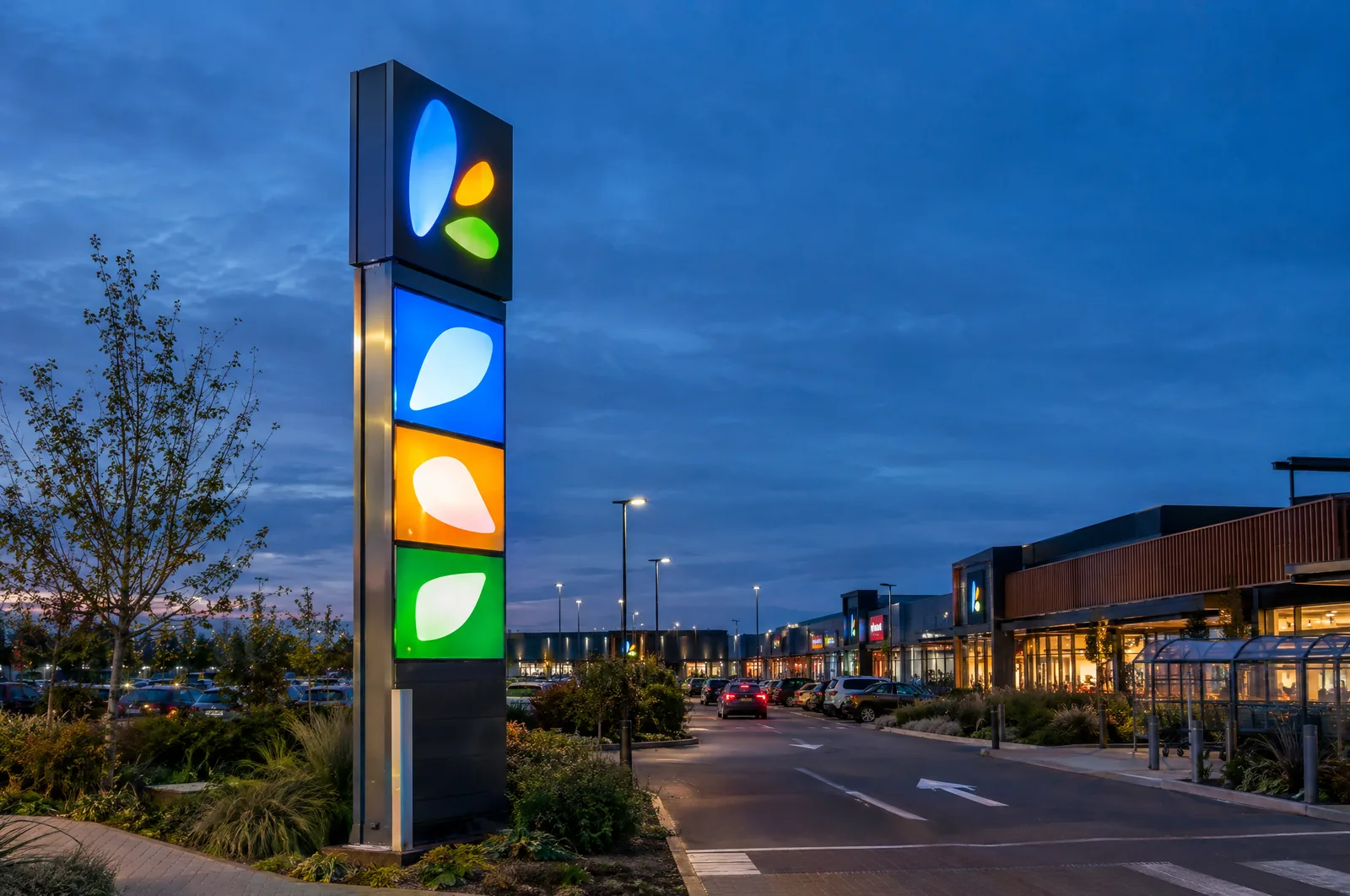
Pylon, totem, welcome sign: how they differ
In the trade these names often overlap, but in practice we distinguish them like this:
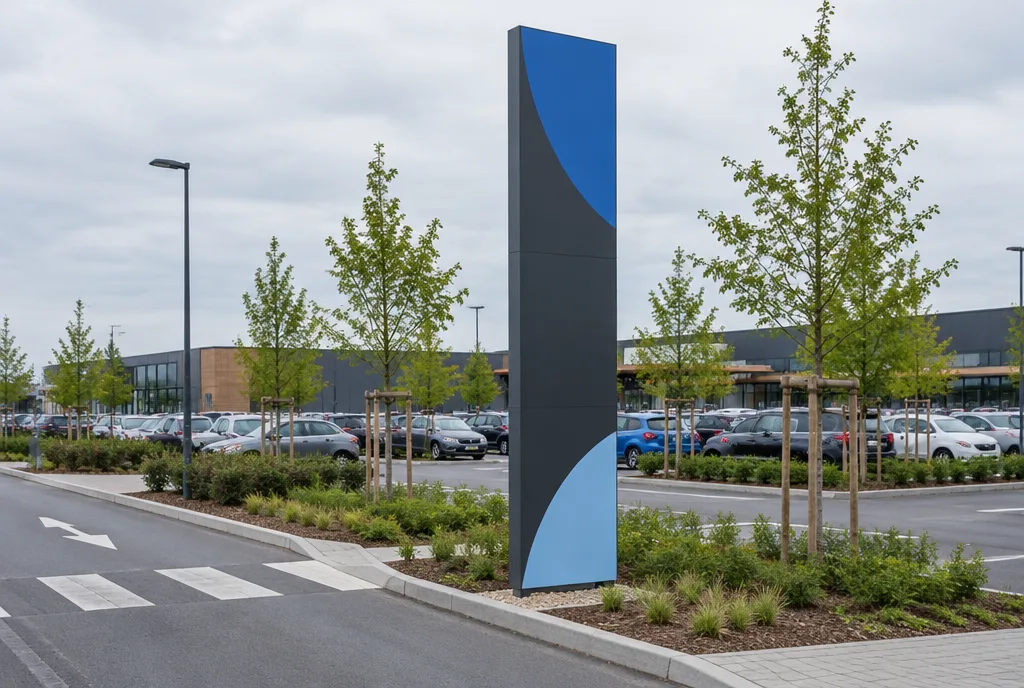
- Pylon – a tall freestanding structure, usually from about 3 m upwards, most often illuminated and double-sided. It has to be visible from the road and from a car. You find them at shopping centres, car dealerships, petrol stations and hotels.
- Totem – lower and slimmer, usually 1.5–2.5 m, often unlit. It guides pedestrians and drivers once they are on site: at the entrance, in the car park, at the junction leading to different buildings.
- Welcome sign – a board or structure at the boundary of a town, municipality, housing estate or plant. Its role is representative rather than sales-driven.
- Fuel price sign – a pylon with price panels at a petrol station; we cover it separately in fuel price sign – what it is.
The name makes little difference to the price. What counts is height, number of faces, illumination and how many businesses need to fit on it.
Types of pylon: how to choose the version
| Type | Where it works | Notes from practice |
|---|---|---|
| Non-illuminated, single-sided | Totem at an entrance, car park, factory site | Cheapest; graphics UV-printed on Dibond |
| Non-illuminated, double-sided | Junctions, entrances approached from two sides | Same structure; the second face costs little extra |
| Illuminated, double-sided | Roadside, sites open after dark | Needs a cable in the foundation and an outdoor power supply |
| With routed logo (only the letters light up) | Showrooms, hotels, office buildings | Dibond face, acrylic logo, a more elegant effect |
| Multi-level for several tenants | Retail parks, office buildings, service centres | Each tenant has its own replaceable panel |
| With a digital or price panel | Petrol stations, car washes, car parks | See the separate guide on fuel price signs |
From experience: by a road with traffic after dark, a non-illuminated pylon is clearly less effective. In winter it gets dark at 4 pm, which is when many businesses see the most customers. If the budget is limited, a lower illuminated pylon is a better choice than a tall one without lighting.
Materials and structure
The frame is almost always galvanised steel: a single post, a frame or two posts with crossbars. It is then clad. We most often use:
- Dibond (aluminium composite) – smooth, rigid, rust-free, takes UV print and vinyl well. For large panels we use a thicker grade with heavier aluminium skins so the surface does not ripple.
- Opal acrylic – for illuminated faces, because it diffuses LED light evenly.
- Powder-coated sheet metal in a RAL colour – for sides and plinths when a specific brand colour is needed.
- 3D letters and logos – applied to the face or rising above the pylon; we describe lighting options in illuminated 3D letters: front-lit, side-lit or halo.
We cut board elements on our own CNC router, print with a UV printer directly onto the board, and fit the lighting using LED modules with a power supply rated for outdoor use.
Foundation, wind and power supply
A pylon is a large surface exposed to wind, set on one or two posts. The force acting on the foundation is considerable, so its size is determined by a structural engineer based on height, face area and soil type. For every pylon we prepare a technical design with drawings and fixings (from approx. €85 net), and the foundation with anchors is built to it.
What needs to be ready before installation:
- Set out the location – away from underground cables and pipes, keeping the required distance from the carriageway and plot boundary.
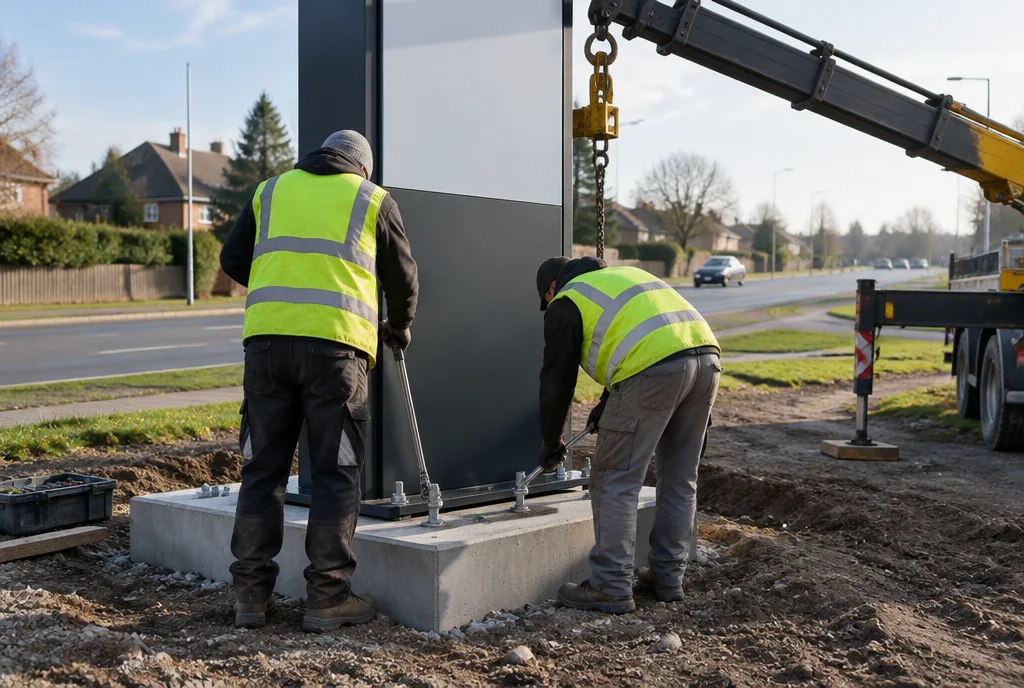
- Pour the foundation with anchors at the exact spacing from the design.
- Run a power cable in a protective duct if the pylon is to be lit.
- Wait until the concrete can take the load.
- Book the installation – for taller pylons with a cherry picker or crane.
The most common mistake we see: the paving is already laid and nobody has planned a cable to the pylon. Breaking up the surface afterwards costs more than a duct in the trench.
- 24 hexpress printing (UV inks need no drying)
- approx. 3 daysstandard lead time
- up to 14 dayslarge and custom projects with installation
Plus courier delivery. Tell us your date — we plan production around it.
Permits and roadside location
Freestanding roadside advertising is an area where rules differ between countries and even between municipalities. Depending on height, distance from the carriageway and local regulations, you may need planning notification, a permit, consent from the road authority or compliance with local landscape or advertising rules. Always check with the local authority before ordering – a general overview is in does a shop sign need permission.
When choosing the spot, look at it through the driver's eyes. The pylon must be visible early enough for someone to slow down and turn into the right entrance. Placed right at the turn-off, it works worse than the same pylon 30–50 metres before it, if the rules and the plot allow. Do not block visibility at the exit either – that is both a safety and a legal issue.
We can take on preparing documentation and arrangements (from approx. €210 net), but the decision is always made by the authority.
How much a pylon costs and how long it takes
Indicative prices from our price list, net:
- non-illuminated totem, Dibond on a steel frame, 2.5 m high – from approx. €750,
- double-sided illuminated pylon, 3 m high – from approx. €2,070,
- double-sided LED light box as the pylon face – from approx. €410 per m²,
- technical design and visualisation – from approx. €85,
- installation: two-person crew at approx. €42 per crew-hour, travel approx. €1 per km both ways, cherry picker from approx. €230 per day.
The foundation and electrical connection are priced separately. The price rises with height above 3 m, a routed logo, 3D letters projecting beyond the outline and unusual shapes. We give the exact amount after the design and confirm it once you contact us.
Production of a large structure usually takes up to about 14 working days from design approval. The schedule must also allow time for permits and the foundation – these are what most often extend the whole project. More about the offer on the outdoor pylons and totems page.
A pylon for a retail park or several tenants
At a retail park, office building or service centre, the pylon carries the logos of several, sometimes a dozen or more businesses. In that case we design it modularly: a top panel with the name of the site and tenant panels of equal height below. Each panel can be replaced without touching the rest when a tenant changes. The managing agent gets one consistent look, and tenants get clear rules on what file to supply and in what size.
It is a good opportunity to agree the design of directional totems in the car park and entrance signage at the same time – we cover this in more detail on the page for shopping centre and retail park managers.