 Signs & Large Format Print
Engraving in laminate, acrylic and metal: what it looks like
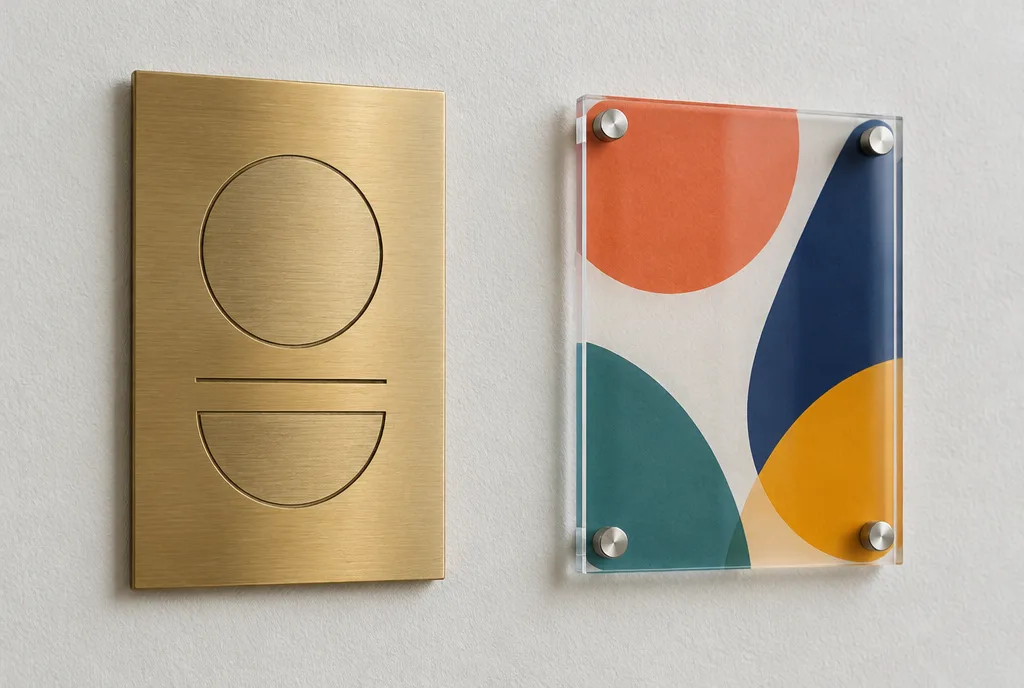
Engraving removes material – with a laser or a cutter – and creates recessed, durable lettering. The result depends on the substrate:
- Engraving laminate – a two-layer sheet, e.g. silver on top and black underneath. Engraving reveals the lower layer and gives contrasting lettering. A classic for door plates, desk signs and machine labels. We check the availability of a specific colour when quoting.
- Acrylic – laser engraving frosts the clear sheet. The lettering is light and frosted, looking best on a dark background or edge-lit. Cast acrylic engraves more distinctly than extruded – we describe the differences in cast vs extruded acrylic.
- Wood and plywood – the laser scorches the surface dark brown. A warm, natural effect for consulting rooms, guesthouses, cafés.
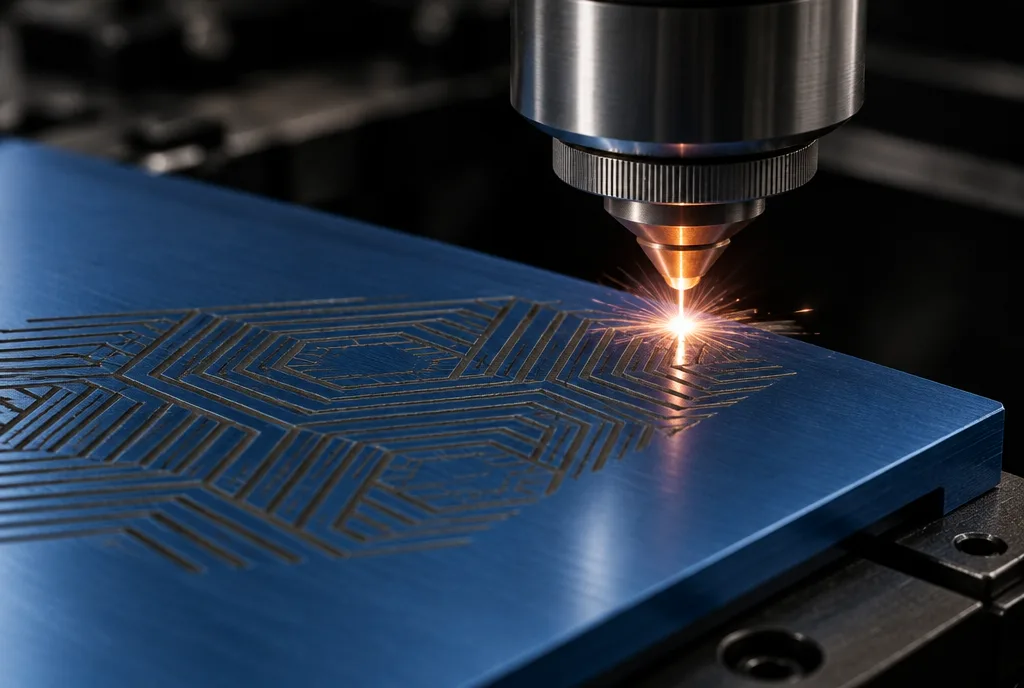
- Metal – aluminium, steel, brass. Engraved with a cutter (mechanical engraving) or specialist lasers. We do mechanical engraving on a CNC router – priced at approx. €4.20 net per linear metre of path plus file preparation. Stainless steel or brass plates are quoted individually.
What can be done with a laser and what with a cutter is covered in our guide laser engraving and cutting.
UV printing on Dibond, glass and acrylic
UV printing applies ink directly to the board and cures it instantly. It can reproduce a logo in brand colours, photos, gradients and small text. We most often print on:
- 3 mm clear acrylic (approx. €43–60 net/m²) – white underlayer included; looks elegant on stand-offs, at reception and on consulting room doors;
- 3 mm Dibond (approx. €35–55 net/m²) – a rigid aluminium composite, the standard for outdoor plates and entrance boards;
- glass – e.g. on doors or glazed partitions; printing on supplied glass costs approx. €24–34 net/m²;
- 3 mm foamed PVC (approx. €21–33 net/m²) – cheap, but for interiors only.
Clear acrylic can be reverse-printed on the back. The graphic is then protected by the thickness of the sheet, and the front shows a smooth, glossy surface. It is the best way to make a print both colourful and resistant to touch. Ready-made solutions are on the door plates and directional signs page.
Comparison: durability, scratches, colour
| Feature | Engraving | UV print on the surface | UV print on the back of acrylic |
|---|---|---|---|
| Colours | one – the material colour or a paint fill | full colour, photos, brand colours | full colour |
| Scratch resistance | very high | good; with heavy handling a laminate is worthwhile | very good – protected by the acrylic |
| Outdoors | yes, depending on the material | yes, on Dibond for years | yes, best in sheltered spots |
| Fine detail | limited by the tool width | very good | very good |
| Look | classic, refined | modern, colourful | deep, glass-like effect |
| When to choose | law firm, public office, rating plates | fascia sign, entrance board, signage | reception, consulting room, office door |
Outdoors the substrate matters most. Acrylic and Dibond withstand sun and frost, while PVC outdoors soon warps – we explain this in Dibond or PVC for outdoor signs. In places exposed to vandalism an anti-graffiti laminate can be applied over the print (approx. €10 net/m²).
A premium effect: stand-offs, layers, combinations
Often the best result comes from combining both techniques. A few proven solutions:
- reverse-printed acrylic on stand-offs – the plate floats 1–2 cm off the wall and casts a slight shadow; stainless steel stand-offs with fitting cost approx. €2.35 net each;
- two layers of acrylic – a back layer with a colour print, a clear front layer with an engraved name; the name can be replaced without changing the whole plate;
- 3D letters instead of a plate – at reception or on the facade; we show them on the shop signs and company nameplates page.
The most common mistake we see: small grey letters on a silver background. In a visualisation it looks elegant; in a corridor it cannot be read from a distance. Contrast matters more than the material effect.
- 24 hexpress printing (UV inks need no drying)
- approx. 3 daysstandard lead time
- up to 14 dayslarge and custom projects with installation
Plus courier delivery. Tell us your date — we plan production around it.
A professional's nameplate: what it should include
A medical practice, law firm, accountancy, psychology practice – the plate at the entrance is often the first contact with a client. Usually it is enough to have:
- Name or company name.
- Professional or academic title and specialisation.
- Floor or unit number if the building has several entrances.
- Opening or consulting hours – ideally on a separate, replaceable element, because they change most often.
- Optionally a phone number or website.
Many professional bodies (doctors, lawyers, notaries and others) have their own rules on how members may advertise – including the content of a plate. Before you order, check your professional body's guidelines. The building owner or managing agent may also set the size and position of plates on the facade.
Examples of signage for specific professions are shown in the sections for accountancy and law firms and psychology practices.
Price and lead time for both methods
Example: a 30 × 20 cm plate, i.e. 0.06 m².
- 3 mm Dibond with UV print: 0.06 m² × approx. €55 = approx. €3.30 net.
- 3 mm acrylic with UV print: 0.06 m² × approx. €60 = approx. €3.60 net, with four stand-offs approx. €13 net.
- Laser engraving in acrylic: depends on the lettering area – surface engraving costs approx. €0.55 net per dm², deep engraving approx. €1.10 net per dm², and the minimum laser order is approx. €14 net.
For a single plate, the price is driven by the minimum order value – €24 net – and the design, not the square metre. That is why it pays to order a full set at once: the entrance plate, consulting room door plates and the unit number. With 10 acrylic plates on stand-offs the cost per piece drops considerably.
We normally make plates in about 3 working days, faster in urgent cases. Our studio can prepare the design if you only have a logo. Information boards for grant-funded projects are covered separately in our guide EU-funded project sign requirements.