 Signs & Large Format Print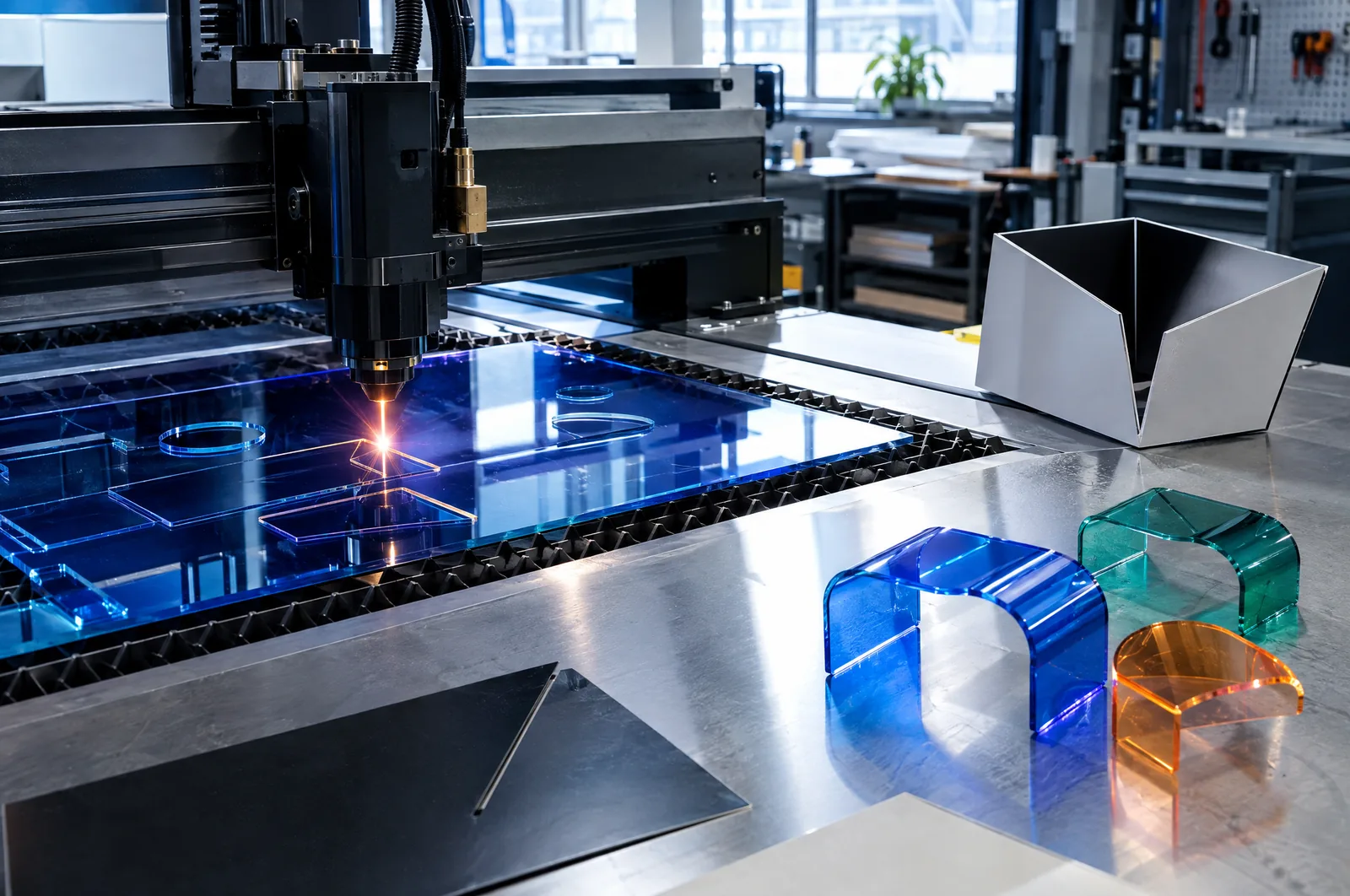
How cast and extruded acrylic are made
Both are the same material – polymethyl methacrylate (PMMA), commonly called acrylic, Perspex or Plexiglas. They differ in how they are produced, and that affects how they behave in processing.
Cast acrylic (GS) is made by pouring liquid resin between two sheets of glass and letting it polymerise slowly. The sheet has long polymer chains, is harder and has little stress. The drawback is a wider thickness tolerance – a 3 mm sheet can be slightly thicker or thinner in places.
Extruded acrylic (XT) is made continuously: molten granulate is pushed through a die and calibrated by rollers. The sheet has a very even thickness and is cheaper to produce, but has shorter chains and stresses along the extrusion direction.
At first glance the sheets look the same. The difference only shows under the laser, the cutter, the glue and the flame.
Laser cutting and edge polishing
Both types laser-cut well – the edge comes out smooth and glossy without extra polishing. The differences:
- GS gives a very clean edge with a lower risk of micro-cracks near the edge later on.
- XT melts more easily, so the laser cuts it efficiently, but stresses remain in the edge. If such a part later comes into contact with solvent-based glue or an alcohol-based cleaner, it can craze into a network of fine cracks.
Thickness matters: we laser-cut acrylic up to about 10 mm, but above about 8 mm edge quality drops and then we recommend routing. Indicative prices:
- laser cutting acrylic up to 5 mm – approx. €0.70 net per linear metre of cut path,
- laser cutting acrylic 6–10 mm – approx. €1.40 net per metre,
- CNC routing material up to 5 mm – approx. €2.10 net per metre, up to 10 mm – approx. €2.80 net per metre,
- flame polishing of edges – approx. €3.30 net per metre, diamond polishing (mirror finish) – approx. €8 net per metre.
In routing GS has a clear advantage: XT has a lower softening temperature, so with the wrong parameters it melts and sticks to the cutter. We cover machining in more detail in CNC routing acrylic, PVC and Dibond. Service: panel cutting and bending.
Heat bending and bonding
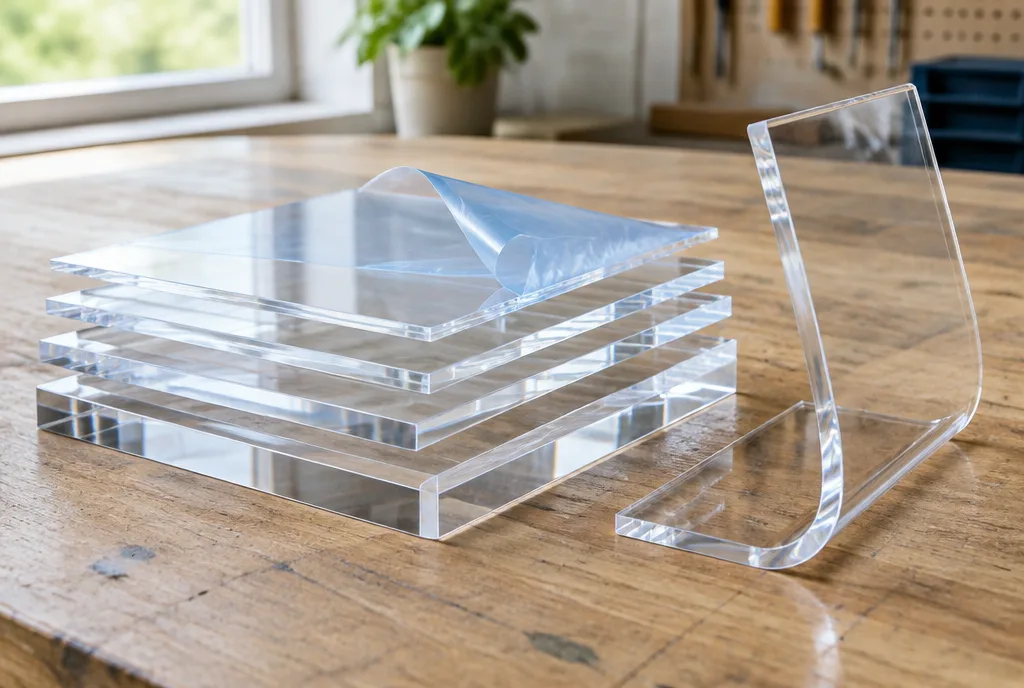
Bending. Acrylic is line-bent after heating along the bend line. XT softens at a lower temperature and bends more easily, but is also more prone to bubbles and distortion if overheated. GS needs more heat, but the bend is stable and deforms less over time. In practice both types work well for bent stands, leaflet holders and displays. Linear heat bending costs approx. €6 net per metre of bend with us.
Bonding. Here we recommend GS. Bonding acrylic with a clear joint (containers, ballot boxes, display cases, box displays) needs stress-free material – XT that has been laser-cut and bonded can crack around the joint, even after a few days. Acrylic bonding costs approx. €8 net per metre of joint with us.
The most common mistake we see: a client cleans an XT display with an alcohol-based cleaner or solvent and a week later has a network of cracks. Clean acrylic with water and a mild detergent and a soft cloth.
Engraving and UV printing on acrylic
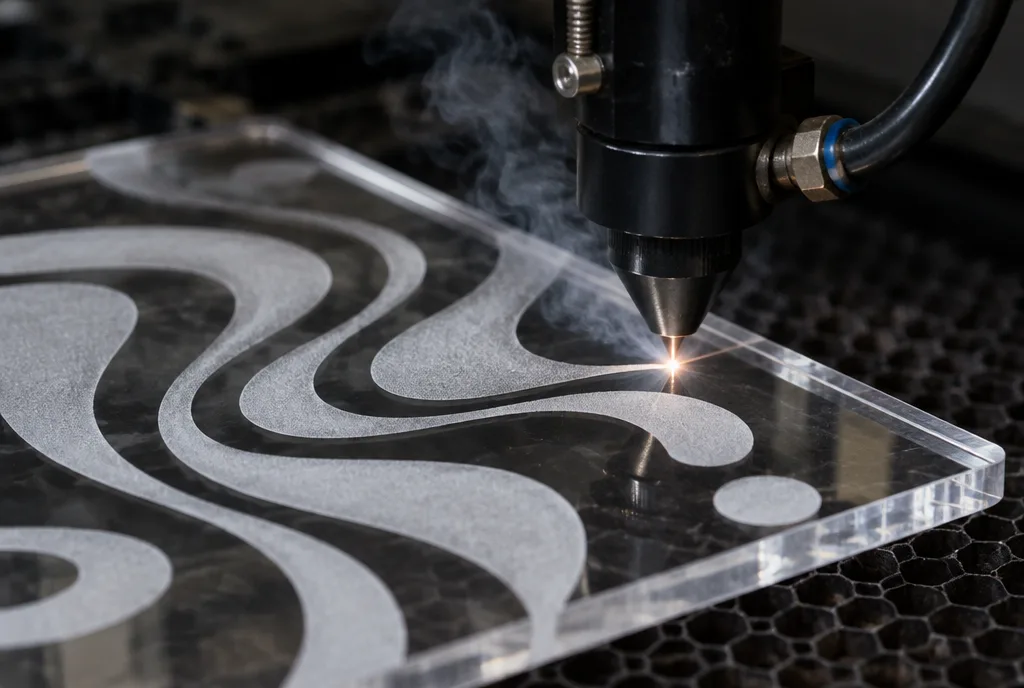
Laser engraving is where the difference is most visible:
- on GS the engraving comes out white, frosted and high-contrast – it looks sandblasted. It works well on plates, awards and signage.
- on XT the engraving is more transparent, lower in contrast, sometimes with melted edges.
So if you are ordering a plate with engraved lettering, a GS sheet gives a better result. Surface engraving is priced from approx. €0.55 net per dm², with a minimum laser order of approx. €14 net. More on the technique in our guide laser engraving and cutting.
UV printing adheres to both types. On clear acrylic we print with a white underlayer (so colours are not see-through), often reverse-printed on the back – then the print is protected by the sheet and seen through it. 3 mm clear acrylic with UV print and white underlayer costs approx. €43–60 net/m². This is how shop signs and company nameplates on stand-offs are made, among other things.
Opal, coloured, mirror and anti-glare acrylic
Besides clear acrylic, there are several variants we use every day:
- Opal – diffuses LED light, so it is the standard for light box faces and illuminated letters. 3 mm opal acrylic with UV print costs approx. €48–70 net/m². For light box faces the sheet must be evenly opal – otherwise the LED dots show through.
- Coloured – opaque or transparent tinted. Good for 3D letters and decorative elements without print.
- Mirror – imitates a mirror and does not shatter. It has a delicate mirror coating on the back and scratches easily, so it is not suitable for heavy use or bending to a tight radius.
- Anti-glare (matt) – reduces reflections, used in poster frames and A-boards.
For unusual colours and variants availability differs between GS and XT – we match the material to the project and let you know if the chosen variant only comes in one version.
Which acrylic to choose: a table
| Application | Recommended type | Why |
|---|---|---|
| Laser-engraved plate | GS | white, high-contrast engraving |
| Bonded display, case, ballot box | GS | no cracking at the joints |
| Routed parts, thick letters | GS | does not melt on the cutter |
| Bent stand, leaflet holder | XT or GS | XT bends more easily, GS is more stable |
| Guard, partition, glazing in a frame | XT | cheaper, even thickness |
| Flat laser-cut parts, long runs | XT | lower material price |
| Light box face | opal acrylic | even light diffusion |
| UV-printed sign on stand-offs | clear, more often GS | rigid, the edge looks good |
If you are not sure what you need, describe what the part is for, how it will be mounted and whether it will be bonded or engraved. We will choose the sheet and thickness. Questions comparing acrylic with other boards are answered in Dibond, acrylic or PVC. We also cut parts in series for countertop displays.
The minimum order value is €24 net. The prices above are indicative – we confirm the final one once we receive the file (DXF, SVG, PDF with outlines) or a dimensioned drawing.