 Signs & Large Format Print
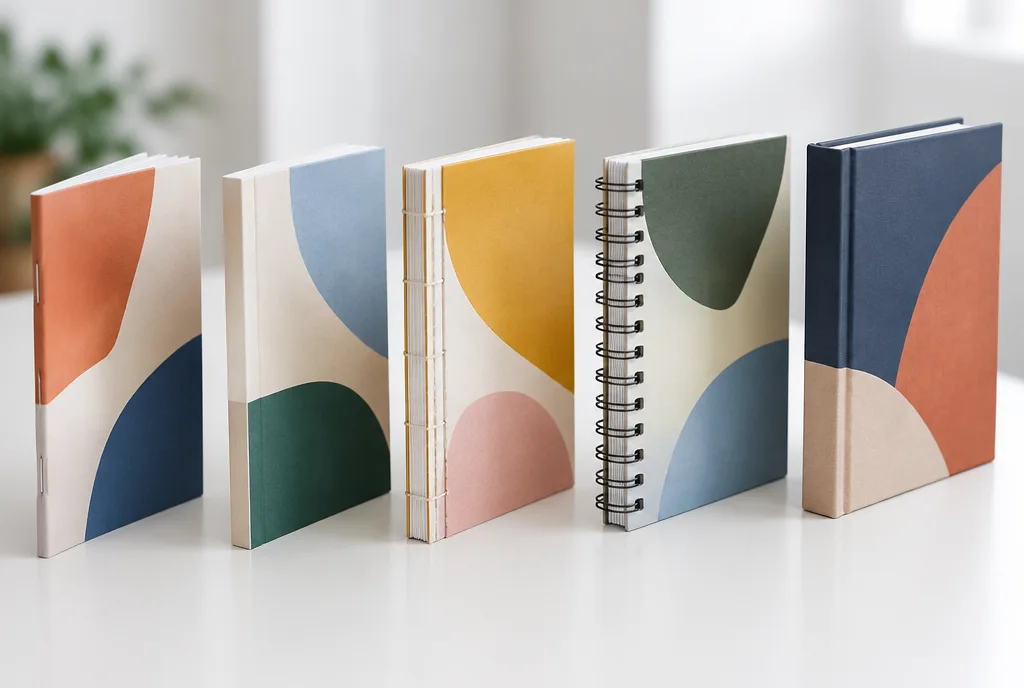
Saddle stitching: when it is enough
The simplest and cheapest binding. Sheets folded in half are nested inside one another and stapled through the spine with two staples (three for large formats). Most store flyers, thin catalogues, event programmes, manuals and brochures are made this way.
Two things you need to know straight away:
- The page count must be divisible by 4. One folded sheet is 4 pages. A catalogue can have 8, 12, 16 or 20 pages – but not 18. If the content fills 18 pages, we add two or the layout has to be tightened.
- The upper limit is thickness, not page count. On thin paper we can stitch more pages, on heavy silk fewer. In practice saddle stitching works up to about 48–64 pages. Beyond that the brochure does not close well, and the middle pages creep forward and end up with a narrower margin after trimming.
Saddle stitching has one advantage few people think about: the catalogue opens flat and sits well on a desk. For a promotional flyer or a price list, that is enough.
Perfect binding and thread sewing
Perfect binding (softcover) means sections or single leaves glued at the spine and wrapped in a heavier board cover. It looks like a paperback: it has a flat spine on which a title can be printed. It is used from about 40 pages upwards, because with fewer pages the spine is too thin for the glue to hold well.
The type of glue matters. PUR adhesive holds more strongly and is more flexible than traditional hot-melt glue, so pages do not fall out even with heavy coated paper and frequent use. For silk-paper catalogues that will be used for a long time, we recommend PUR.
Thread-sewn binding is the most durable option. Sections are sewn with thread, then glued and bound. A sewn book opens better and does not fall apart over the years. It is used for albums, books meant to last and publications that will be opened often. It is more expensive and takes longer, but you can feel the difference in your hands.
Spiral and wire-o binding
Spiral binding means punching holes along the edge of the pages and threading a plastic coil or double wire (wire-o) through them. It offers two things no other binding does:
- the publication lies completely flat and can be folded back 360 degrees,
- the page count does not have to be divisible by 4 – you can add a single leaf.
That is why spiral binding is standard for wall calendars, notepads, machine-side manuals, training materials and price lists used at the counter. The drawbacks are no spine with a title – such a publication is invisible on a shelf – and a slightly less elegant impression for a premium catalogue. A clear plastic front cover and a rigid board back are often added.
Hardcover: books and premium catalogues
A hard cover is binder's board covered with printed paper or cloth. The book block can be glued or thread-sewn. It is chosen when a publication is meant to represent the company for years: anniversary albums, monographs, premium catalogues, books.
It is the most expensive and slowest binding, because several extra manual steps are involved. An example from our price list: 100 A5 hardcover books, 164 pages, black-and-white interior on 90 g uncoated paper, cost approx. €700 net. This is an indicative price – we confirm it after reviewing the design.
A hardcover is easy to enhance: embossing, hot foil stamping, spot UV on the cover. More on this in print finishes.
- 24 hexpress printing (UV inks need no drying)
- approx. 3 daysstandard lead time
- up to 14 dayslarge and custom projects with installation
Plus courier delivery. Tell us your date — we plan production around it.
Page count and choice of binding
| Binding | Page count | Look and durability | Typical uses |
|---|---|---|---|
| Saddle stitch | 8–64, divisible by 4 | Light, economical | Store flyers, thin catalogues, programmes, manuals |
| Perfect bound (hot-melt) | from approx. 40 | Flat spine, medium durability | Reports, short-life catalogues |
| Perfect bound PUR | from approx. 40 | Flat spine, strong | Silk-paper catalogues, annual price lists |
| Thread-sewn | from approx. 48 | Very durable, opens well | Albums, books, long-life publications |
| Spiral / wire-o | any | Lies flat, no spine | Calendars, notepads, manuals, training |
| Hardcover | from approx. 48 | Most prestigious | Books, albums, premium catalogues |
The limits are approximate and depend on paper thickness. 170 g silk builds up a spine faster than 80 g uncoated paper, so with heavy paper the switch from saddle stitching to perfect binding comes earlier. If you are not sure, send us the page count and paper type and we will advise. We cover the whole ordering process in company catalogue: page count, binding, paper and print run.
How to prepare the file for a specific binding
Each binding needs a slightly different file. The key rules:
- Saddle stitch – file in consecutive single pages (1, 2, 3…), not in imposed spreads; we do the imposition. For thicker brochures leave a larger outer margin, because the middle pages are narrower after trimming.
- Perfect binding – leave a wider margin on the spine side (at least about 10–15 mm), because part of the page disappears into the binding. Do not place important elements or graphics running across the centre of a spread.
- Perfect bound and hardcover covers – prepared as one file: back + spine + front. Spine width depends on page count and paper; we give it to you before the cover is designed. Hardcovers also need extra for wrapping the cover around the board.
- Spiral – leave about 10–15 mm clear on the punching side.
- Always 3 mm bleed and a CMYK PDF – details in print-ready PDF: export settings.
We check every file before printing as part of the order. If you would rather leave the layout to us, our studio will do it – see graphic design and DTP.