 Signs & Large Format Print
Folding vs creasing: why heavier paper needs a crease
Folding is simply bending the sheet in a folding machine. With thin paper, e.g. 115–135 g silk, folding alone is enough – the paper bends cleanly.
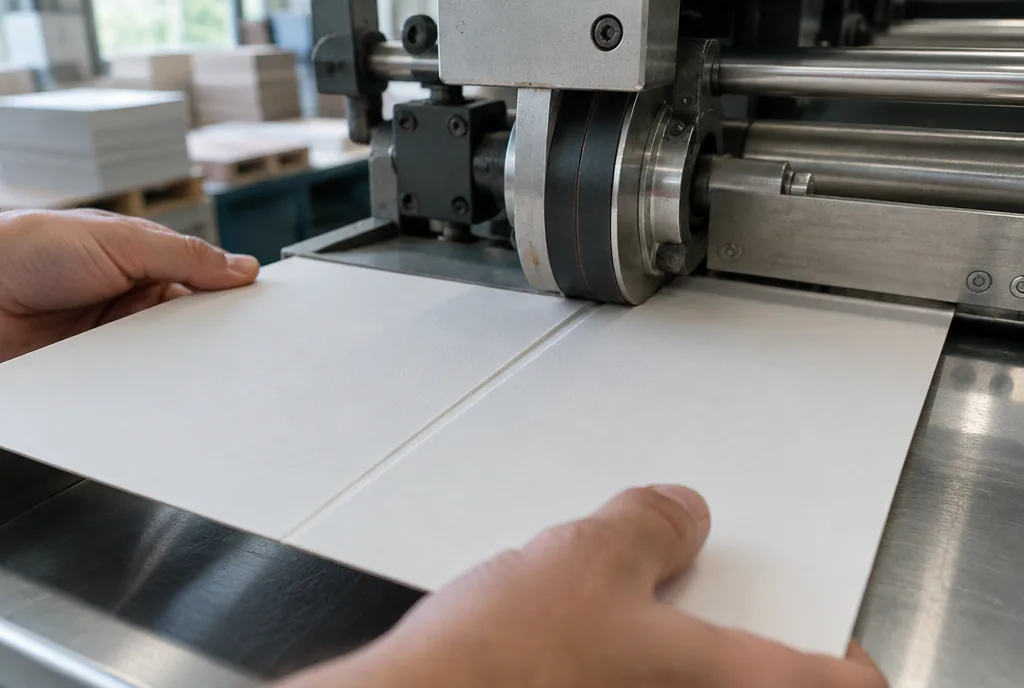
Creasing presses a groove into the paper along the future fold line. Without a crease, the fibres of heavier paper break along the fold and the ink cracks, revealing white paper underneath. This is especially visible with dark backgrounds and solid colour across the fold.
The rule of thumb we use:
- up to about 150 g – we fold without creasing,
- 170 g – depends on the grain direction and colour on the fold; with a dark background we crease,
- from about 200 g, boards, covers, invitations – always creased.
Creasing adds one operation, but the difference in appearance is huge. A cracked fold on a leaflet with a dark background looks sloppy, and nothing can fix it afterwards.
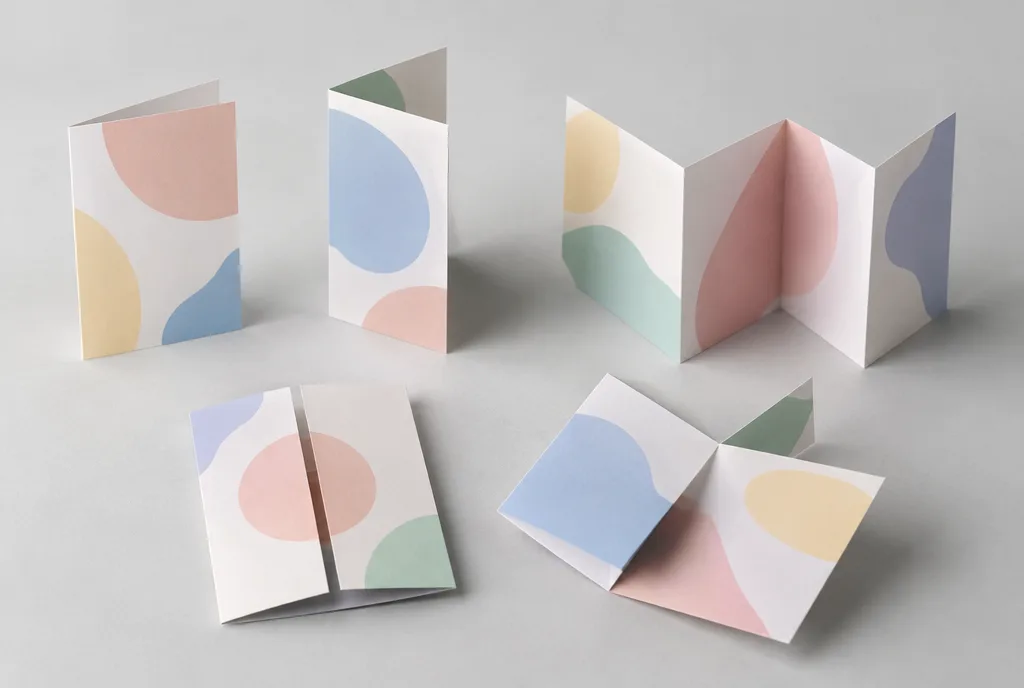
Fold types and what they are used for
| Type | What it looks like | Typical format | Used for |
|---|---|---|---|
| Single fold (half fold) | Sheet folded once, 4 pages | A4 → A5, A5 → A6 | Invitations, proposals, menus, 4-page leaflets |
| Roll fold (C fold, letter fold) | Two folds inwards, 6 pages | A4 → DL | Sales leaflets, price lists, information brochures |
| Z fold (concertina, zigzag) | Panels folded alternately | A4 → DL, longer strips | Maps, timetables, manuals, step-by-step leaflets |
| Gate fold | Two side flaps folding inwards | A4, A3 | Product presentations, statement invitations |
| Cross fold | Folded in half, then in half again across | A3 → A5, A2 → A4 | Store flyers, plans, maps, unstitched brochures |
| Double gate fold | Flaps folded inwards, then the whole folded in half | A3, longer formats | Extended leaflets, premium menus |
A roll fold and a Z fold both give 6 pages from A4, but they read differently. With a roll fold the reader opens the leaflet like a letter – first the middle, then the inside. A Z fold opens like a map and presents content in sequence well: step 1, step 2, step 3. For maps and plans with many panels we usually combine a Z fold with a cross fold – more on the folded maps page.
How to set panel widths
This is the most common file error we see. The designer divides A4 (297 mm) into three equal 99 mm panels, and then the roll fold does not close – the panel tucked inside pushes against the fold, the paper bulges or the edge sticks out.
With a roll fold the inner panel (the one that folds in first) must be about 2–3 mm narrower. For A4 a typical split looks like this:
- roll fold: 100 + 100 + 97 mm – the 97 mm panel is the one tucked inside,
- Z fold: 99 + 99 + 99 mm – here panels can be equal, because none hides inside,
- gate fold from A4: two flaps of about 73 mm and a centre of about 150 mm.
With heavier paper the difference can be larger, because the paper thickness itself takes up space at the fold. That is why we always ask how the leaflet is to be folded – we check the file for this as part of the order. The safest approach is to ask us for a template with fold lines, or print a dummy, fold it by hand and mark which side is the cover.
Paper weight and grain direction
Paper has a grain direction – just as wood has a grain. Folding along the grain is smooth; folding across it is riskier: the paper resists and heavier stocks crack. With thin leaflets the difference is small, but with 170–250 g silk and catalogue covers it is visible.
In practice:
- we arrange items on the press sheet so that the main fold runs along the grain,
- with a cross fold one fold always runs against the grain – that is where creasing matters most,
- solid dark colour across the fold line increases the risk of visible cracking; if possible, shift the background or add a lighter element on the fold,
- matt or gloss lamination on the outside protects the ink and reduces cracking, but a heavy laminated cover still needs creasing.
We cover paper choice in more detail in which paper for flyers.
- 24 hexpress printing (UV inks need no drying)
- approx. 3 daysstandard lead time
- up to 14 dayslarge and custom projects with installation
Plus courier delivery. Tell us your date — we plan production around it.
Files for folded leaflets: what to remember
- Prepare both sides of the sheet: outside and inside, each as a full, flat sheet with 3 mm bleed.
- On the outside, panels run in a different order than inside. With a roll fold, the left outside panel is the one that ends up tucked inside, the middle is the back of the leaflet and the right is the cover.
- Mark fold lines on a separate layer or in a note. We do not print them, but they help a lot when checking.
- Keep text at least 4–5 mm from fold lines and trim edges.
- Do not place small text or faces on a fold line.
Ready-made templates for many formats are in print templates. If you prefer, our design studio can prepare the file and the design.
Which fold for a menu, map or sales leaflet
- Takeaway menu – roll fold or Z fold from A4; fits a DL envelope and a leaflet rack.
- Table menu – single fold from A3 to A4, heavy paper with creasing and lamination so it survives many hands.
- Tourist map, event plan – Z fold combined with a cross fold; once folded it fits in a pocket.
- Company sales leaflet – roll fold from A4, or a single fold from A4 to A5 when the offer has larger photos.
- Invitation – single or gate fold on heavy board, always creased; details on the invitations, vouchers and cards page.
Indicative prices from our price list, net: 6-page DL leaflet, 130 g silk, 1,000 pcs – approx. €90; 4-page A5 leaflet, 130 g silk, 1,000 pcs – approx. €90. More on the flyers and folded leaflets page. Other formats and folds are quoted from a short description.