 Signs & Large Format Print
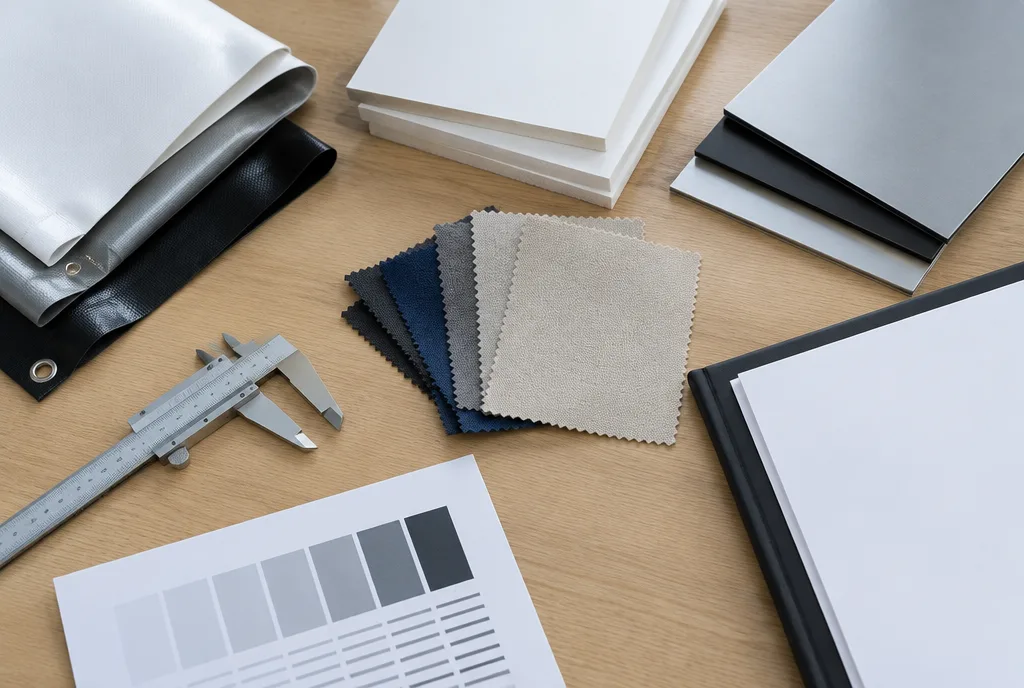
How to describe material, dimensions, finishing and installation
A contractor prices exactly what is written. If something is missing, they will add a risk margin or ask a question that lengthens the procedure. For each item it is worth giving:
- Trimmed size (of the finished product) in centimetres or millimetres and the number of pieces.
- Material with a parameter – e.g. aluminium composite panel 3 mm thick, PVC banner approx. 510 g/m², matt coated paper 170 g/m².
- Print – single or double-sided, full colour, with the required outdoor resistance if the product will stand outside.
- Finishing – eyelets, welded hems, laminate, rounded corners, mounting holes, support structure.
- Delivery and installation – an address or list of addresses, whether the contractor installs, on what substrate (ground, wall, fence), who is responsible for the foundation.
- Design – whether the contracting authority supplies finished files or design is on the contractor's side, and how many rounds of revisions.
For information boards for EU-funded projects, the programme's requirements also apply – we describe them in our guide EU-funded project sign requirements. Always refer to the current guidelines of the relevant programme, because they change between funding periods.
Parameters instead of trade names: equivalent descriptions
Across EU public procurement a general principle applies: the subject of the contract is described in a way that does not hinder fair competition. In practice this means not naming a specific manufacturer, brand or model, and if this is exceptionally necessary, allowing equivalent solutions and stating how equivalence will be assessed. The exact wording of the rules in your country and their interpretation are best confirmed with the procurement officer at your institution.
For promotional materials this can be done very concretely. Instead of the trade name of a panel, give the thickness, core type and skin thickness. Instead of a roller banner model – width, height, cassette material, type of graphic and whether the cassette must allow the print to be replaced. Instead of a pen brand – the barrel type, ink colour, branding technique and print area.
Such a description has one more advantage: bids can be compared, because everyone is pricing the same product.
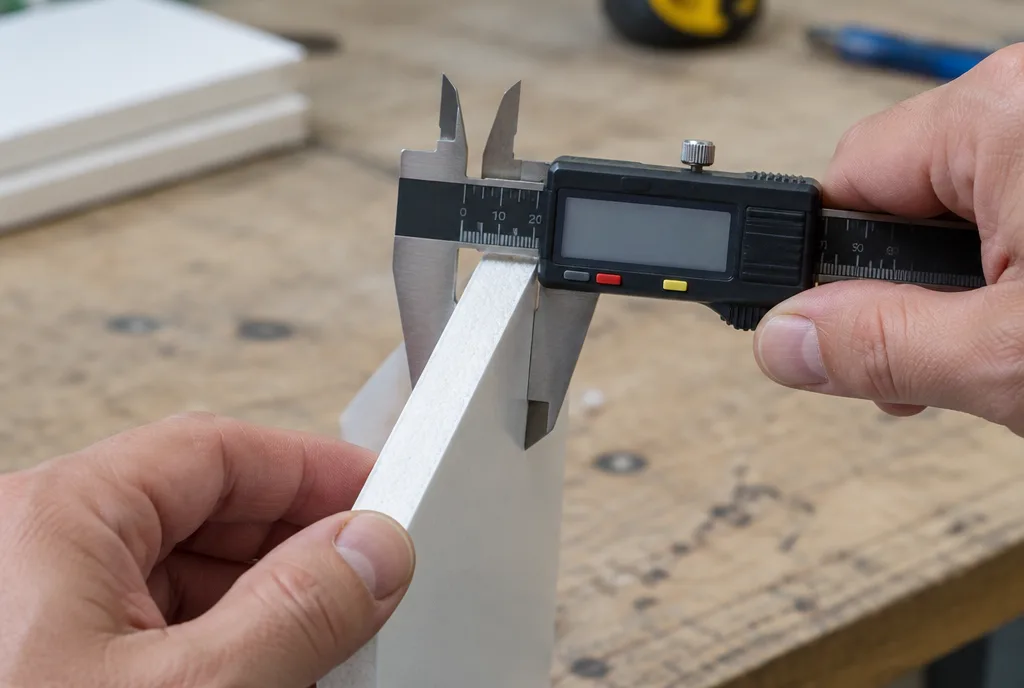
Samples, visualisations and design approval
The contracting authority has the right to check that it gets what it ordered. But a sense of proportion is needed – requiring physical samples of every item at bid stage raises the cost of taking part and puts off some contractors.
Sensible solutions we see in well-prepared tenders:
- Design approval before production – the contractor sends a PDF or visualisation, the authority has a set time for comments (e.g. a few working days), and the lead time runs from approval.
- A material sample or test print only for items where colour or material really matter, e.g. a city's visual identity.
- An installation visualisation for signs and building signage, to check proportions on site.
What a good approval process looks like from the contractor's side is described in our guide approving a design for print.
- 01Brief
Description, sizes, site photos and deadline — a few sentences are enough.
- 02Design and quote
Our designers prepare artwork or a visualisation and you get a price.
- 03Approval
You approve the design; for brand colours we provide a proof.
- 04Production
35+ machines in our own plant in Poland: 3.2 m UV print, CNC, laser, 3D, sewing.
- 05Installation or delivery
Own crews and vehicles across Europe, partner network, couriers worldwide.
Delivery deadlines and penalties: realistic clauses
Too short a deadline does not speed up delivery; it raises prices – contractors add the risk of penalties or do not bid at all. A few practical rules:
- Count the deadline from design approval, not from signing the contract, if design is on the contractor's side.
- Allow for realistic production time. In large format printing the standard is a few working days, but signs on structures set in the ground, building signage or large publishing runs need more time, and installation also depends on the weather.
- With many locations, provide a schedule or let the contractor propose the order.
- Set contractual penalties in proportion to the contract value and the severity of the delay. High penalties for minor shortcomings lead to more expensive bids.
General lead times for different products are collected in our guide print turnaround times and 24h express.
- 24 hexpress printing (UV inks need no drying)
- approx. 3 daysstandard lead time
- up to 14 dayslarge and custom projects with installation
Plus courier delivery. Tell us your date — we plan production around it.
Division into lots and contracts with options
Promotional materials are usually a very varied range: signs on structures, print, merchandise, roller banners. Few contractors make everything in-house – the rest is bought in with a margin. Dividing the contract into lots, e.g. (1) signs and signage, (2) print and publications, (3) printed merchandise, usually brings more bids and lower prices in each lot.
When you do not know exact quantities (e.g. the number of boards depends on how many projects receive funding), a contract with a basic quantity and an option for additional pieces on the same terms works well. For municipalities running many projects at once we describe this model in our guide project signs for municipalities.
We have worked with the public sector for years – public data from 2009–2025 shows 55 contracts for 38 contracting authorities in Poland. We work with, among others, municipalities and town halls and district authorities.
The most common specification mistakes that raise prices
| Mistake | Effect | Better wording |
|---|---|---|
| Information board with no material or thickness | Bids for different products, prices not comparable | Material, thickness, print, structure, size |
| No information on installation | Some bids include installation, some do not | State plainly: delivery or delivery with installation, type of substrate |
| Deadline from contract signature with design on the contractor's side | Risk of penalties, higher prices | Deadline from design approval |
| Trade name with no equivalence description | Clarification questions, risk of challenges | Technical parameters and equivalence criteria |
| Everything in a single lot | Fewer bids, intermediary margins | Division into lots by type of product |
| No list of delivery addresses | A transport risk margin added | List of locations, or the region and number of sites |
If you are preparing a specification and want to check whether it can realistically be priced, send us the draft – we will tell you what is missing from a production point of view. Indicative prices for boards are in the description of EU and grant-funded project boards, e.g. a 200 × 100 cm Dibond board on a galvanised frame from approx. €165 net; we confirm the exact price once you contact us. We do not give legal advice – the formal aspects of the procedure remain the contracting authority's responsibility.