 Signs & Large Format Print
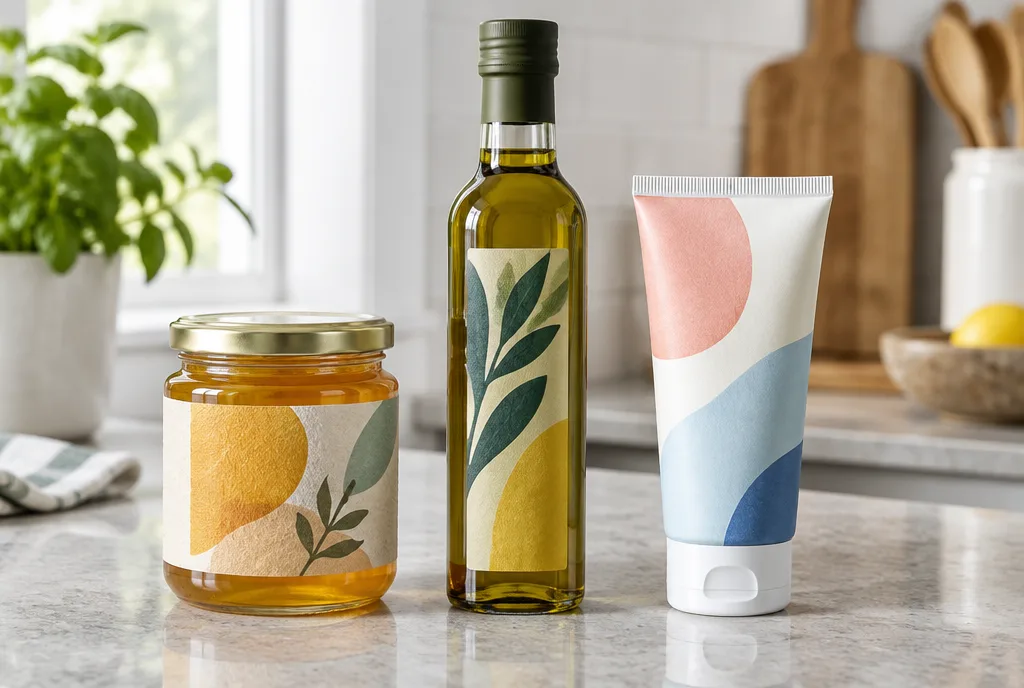
Conditions first, looks second
The most common mistake we see with labels is choosing the material because it looks nice on a sample. Then it turns out the jar sits in a fridge, condensation forms on the glass and after a week the paper label wrinkles or falls off. That is why, before we ask about colours, we ask a few simple questions:
- What the label has to stick to – glass, carton, film, plastic (PET, PP, PE), metal, wood.
- Pack shape – a flat panel, a cylinder, a small diameter, a surface that gets squeezed (a tube, a soft plastic bottle).
- Conditions – fridge or freezer, bathroom, contact with oil, alcohol, chemicals, washing of returnable packaging.
- Application method – by hand or by machine (then the roll, unwind direction and core matter).
- How long the label has to last – a few weeks on the shelf or several years in a warehouse.
The material and adhesive follow from these answers. The look is refined afterwards – with varnish, laminate, foiling or a textured paper.
Paper or film: materials compared
| Material | Where it works | What to watch |
|---|---|---|
| Coated paper (gloss/matt) | Dry products, cartons, jars outside the fridge, preserves, tea | Moisture and grease – without varnish it stains and wrinkles |
| Uncoated paper | Labels to write on with a pen, dates, batch numbers | Less saturated colours, absorbs dirt |
| Textured, laid or kraft paper | Wine, craft beer, natural cosmetics, premium products | Moisture in a cellar or ice bucket – choose a wet-strength version |
| White PP film | Cosmetics, household chemicals, chilled food, oils, PET bottles | On squeezable packs a softer PE film works better |
| Clear film | A no-label look on glass and clear bottles | Colours on a clear base need a white underlayer |
| Metallised film (silver, gold) | Spirits, cosmetics, festive products | Colour printed on metal looks different from on white – a proof is worthwhile |
| Polymeric film | Long life, slight curves, technical labelling | More expensive than monomeric – not always needed for a short run |
In practice most food producers and cosmetics makers end up with white PP film or varnished paper. Paper is cheaper and gives a nicer, natural look; film is the safer choice where the product is in contact with water or grease. Indicative rates for printing on film from our price list: white monomeric approx. €6–12 net/m², clear approx. €7–14 net/m², polymeric approx. €9–16 net/m² – depending on quantity. The price of die-cut labels on rolls is calculated for the specific project.
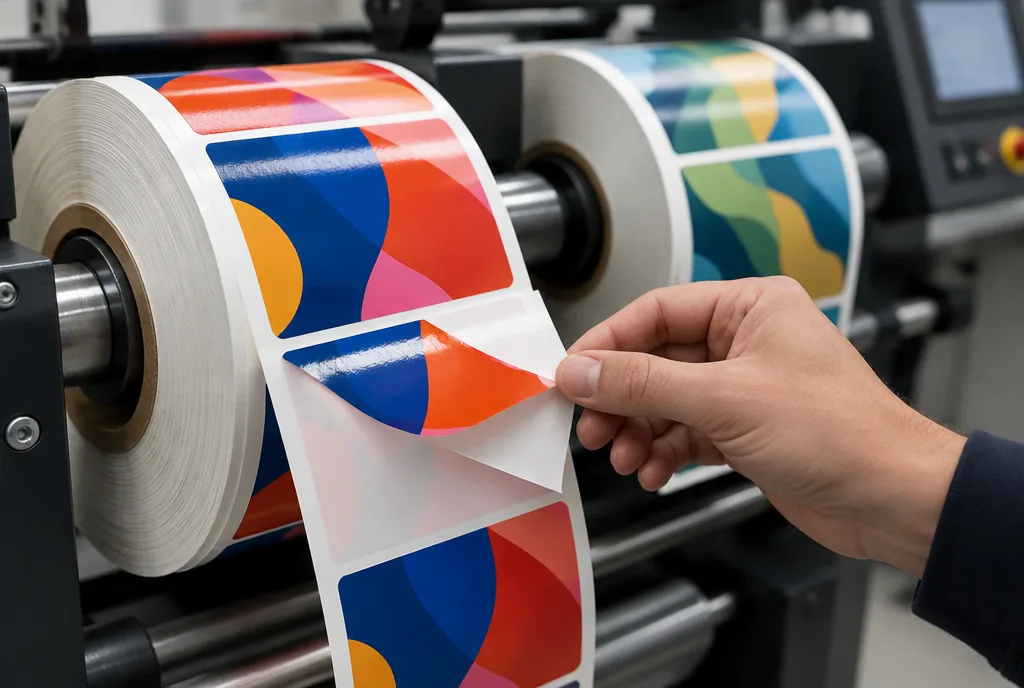
Adhesive: permanent, removable or low-temperature
The adhesive is the other half of a label and often more important than the material itself.
- Permanent – the standard. The label stays on for good and tears if you try to remove it. Good for most single-use packaging.
- Removable – comes off without residue. Useful for returnable jars, crates, reusable packaging, price stickers and temporary markings.
- Low-temperature (freezer-grade) – when the product goes into a freezer or the label is applied to cold, chilled packaging. Ordinary adhesive grips poorly on a cold, misted surface.
- High-tack adhesive – for rough, greasy or tightly curved surfaces, e.g. small vials, wood, recycled board.
The practical rule: if the product will be kept in a fridge or freezer, tell us at the start. That one sentence saves a whole batch of labels. With new packaging we always advise a test on the real jar or bottle in the target conditions.
Finishes: varnish, laminate, foiling
A finish is not just about looks. Varnish or laminating film protects the print from abrasion, moisture and grease – on paper it is often essential for the label to survive transport and the shelf.
- Matt or gloss varnish – basic protection that also changes how colour is perceived.
- Laminating film – stronger protection, good for cosmetics and chemicals.
- Spot varnish, 3D varnish, gold or silver foiling – highlighting the logo or product name, typical on wine, spirits and premium cosmetics.
How the individual finishes work and when they make sense is covered in more detail in our guide print finishes. Finish prices depend on quantity and the area of the effect, so we quote them together with the whole label – see also print finishing: 3D varnish, film and foil stamping.
- 24 hexpress printing (UV inks need no drying)
- approx. 3 daysstandard lead time
- up to 14 dayslarge and custom projects with installation
Plus courier delivery. Tell us your date — we plan production around it.
How to specify size, unwind direction and core diameter
For hand application, size and shape are enough – and then sticker sheets are often more convenient. For a labelling machine more data is needed, because a wrongly wound roll simply will not work in the machine. What to prepare for an enquiry:
- Label size and shape – rectangle, oval, circle, custom die-cut. For shapes, give the corner radius.
- Quantity – in total and per design. Several flavour versions of the same size are usually one order with several designs.
- Core diameter – the core the roll is wound on. 25, 40 and 76 mm are the most common; check the labeller manual or measure your current roll.
- Maximum outer roll diameter – the largest roll the machine holder will take.
- Unwind direction – labels wound outside or inside the roll, and which edge leads out of the machine (top, bottom, side). The simplest thing is to send a photo of an old roll.
- Gap between labels and number of lanes – if the machine requires it.
The differences between rolls and sheets are described in our guide labels on rolls or sheets, and standard self-adhesive roll labels can also be priced in our calculator at etykietownia.com.
Labels and regulations: in brief
Labels on food, cosmetics or chemicals must carry specific information (ingredients, allergens, weight, dates, hazard pictograms, etc.), and their scope and minimum font size depend on the product category and country of sale. The label content is the producer's responsibility – it is worth checking it with a food technologist, a laboratory or a regulatory adviser. We look after the technical side: whether text of a given size will be legible in print, whether the barcode has enough contrast and a quiet zone, whether elements cross the cut line. We review the file before production as part of the order price.