 Signs & Large Format Print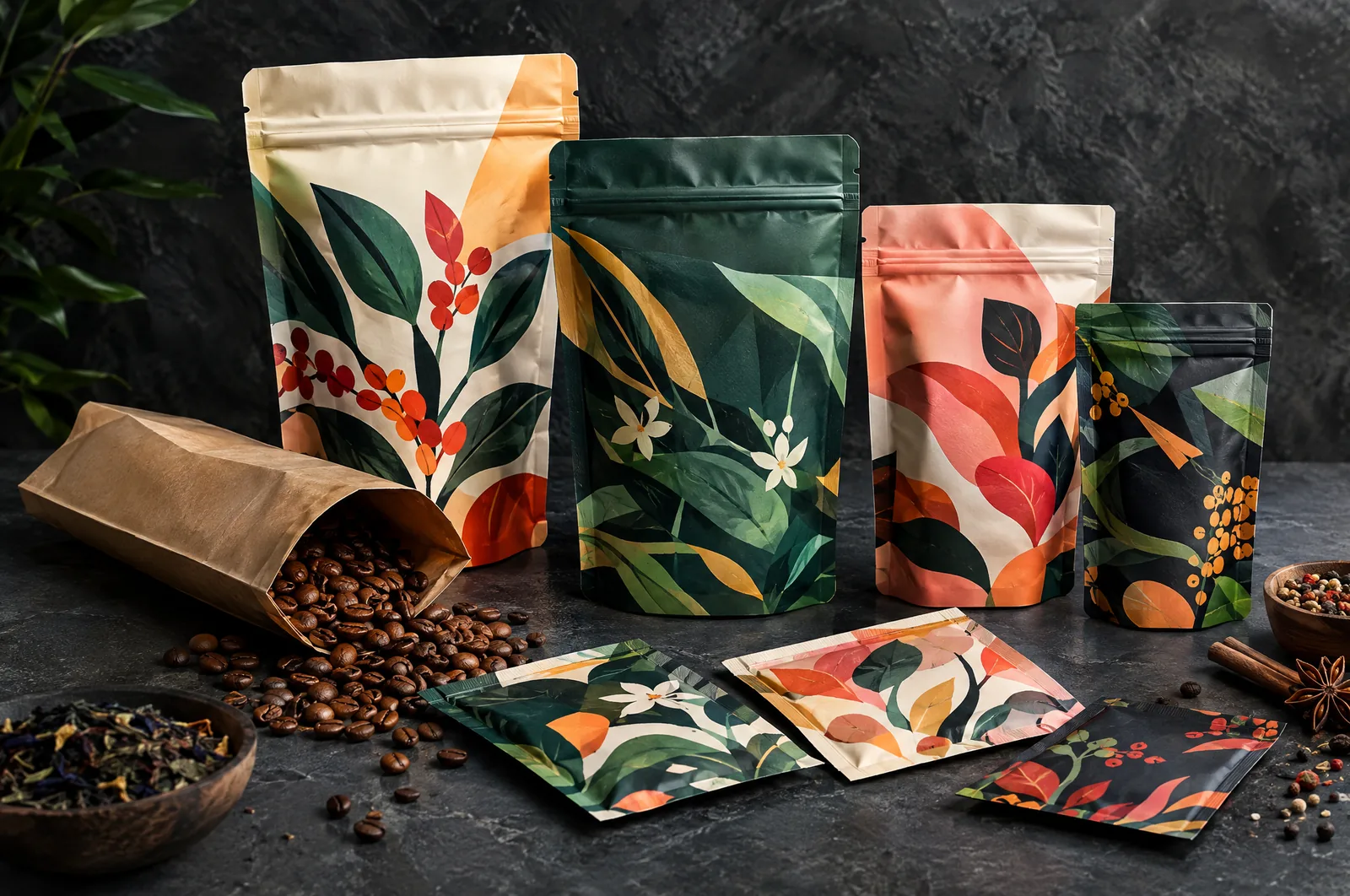
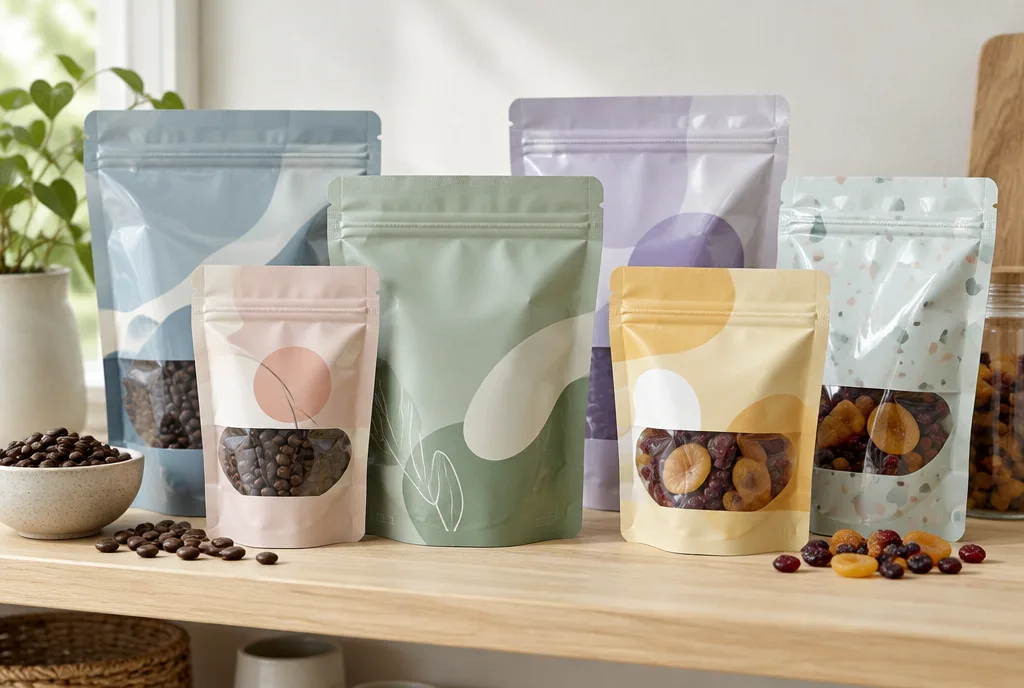
Doypack, sachet, flat bottom: types of flexible packaging
| Type | What it looks like | Typical use |
|---|---|---|
| Doypack (stand-up pouch) | pouch with a base gusset, stands on the shelf | coffee, tea, spices, dried fruit and nuts, pet food, supplements |
| Flat sachet (three- or four-side sealed) | flat envelope with no base | samples, single portions, cosmetics, small quantities of spices |
| Flat bottom (box pouch) | flat, rectangular base, five printable panels | whole bean coffee, granola, premium products in larger weights |
| Side gusset bag | gussets on the sides, often closed with a seal or clip | coffee, flour, larger packs |
| Film on a roll | laminate wound on a roll, formed on a packing machine | automated production, long runs |
For a small producer packing by hand or semi-automatically, the choice is almost always between a doypack and a sachet. A flat bottom pouch looks striking, but it is more expensive and needs more careful filling. Rollstock only makes sense once you have a packing machine.
Laminates and barriers: moisture, oxygen, aroma, light
Flexible packaging is almost always a laminate, i.e. several layers bonded together. The outer layer takes the print, the middle provides the barrier, and the inner layer seals and is in contact with the product. The most common structures:
- PET/PE – clear or printed, a basic barrier. For dry products with a shorter shelf life.
- Metallised PET/PE – a silvery core, a better barrier against oxygen and light. Often used for coffee and snacks.
- PET/ALU/PE – the aluminium layer gives the strongest barrier. Coffee, products sensitive to oxidation, long shelf life.
- Kraft paper/PE or kraft/PET/PE – a natural look, popular for eco and artisan products. The barrier comes from the inner layer.
- Mono-material laminates (e.g. all-PE or all-PP) – designed with easier recycling in mind; their properties differ somewhat from classic laminates, so they must be matched to the product.
When choosing, start with the product, not the look. Coffee needs a barrier against oxygen and aroma loss, salt and sugar against moisture, fatty products need grease resistance. A window in the pack looks good but lets light in, so it is not suitable for everything.
Closures and extras: zip, valve, spout, tear notch
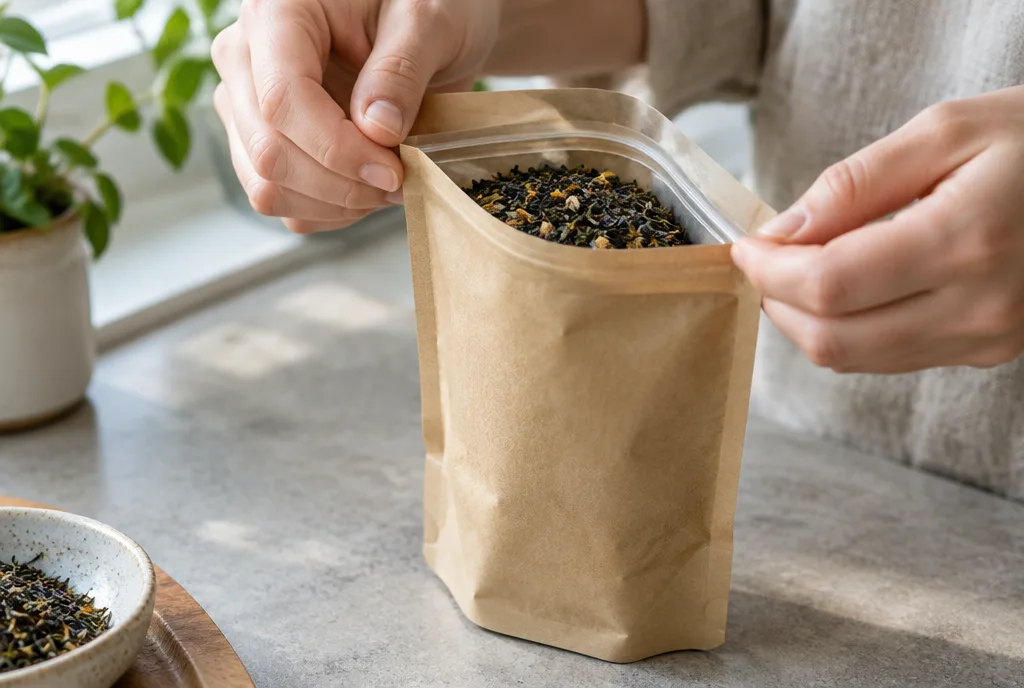
- Press-to-close zip – standard on doypacks for products used repeatedly. The customer opens it, pours a portion, closes it.
- Slider closure – easier to use, more expensive.
- Degassing valve – one-way, for freshly roasted coffee, which gives off gas. Without a valve the pouch swells.
- Spout – for liquids, purées, sauces, baby food.
- Tear notch – a small thing whose absence annoys customers.
- Hang hole (euro slot) – when the product has to hang on a peg hook in store.
- Window – a clear area showing the product.
Every extra raises the unit price and may change the minimum run. It is worth deciding at the outset what is essential and what is just nice to have.
Printed pouch or a label on a plain doypack
This is the most important decision for a small brand, because costs and flexibility depend on it.
A fully printed doypack looks best: graphics across the whole surface, including the sides and base. But it needs a separate design for each variant (flavour, weight), and with conventional print methods it needs printing plates or cylinders whose cost is only spread over a large run. Digital printing on laminates has lowered the entry threshold, but the maths is still different from a label.
A plain doypack (white, black, kraft, clear) with a label is the starter solution. You buy the pouches in small quantities and put the whole identity on a product label. One pouch type covers ten flavours – you only change the label. We print labels in short runs, and roll labels suit manual and semi-automatic labelling. How to choose the label material is covered in product labels: which material.
Our practical advice: start with a plain doypack and a label, check your sales, and only move bestsellers to fully printed packaging.
- 24 hexpress printing (UV inks need no drying)
- approx. 3 daysstandard lead time
- up to 14 dayslarge and custom projects with installation
Plus courier delivery. Tell us your date — we plan production around it.
Minimum run and what drives the cost
Several things affect the price of printed flexible packaging at once:
- Size and capacity – more laminate means a higher unit price.
- Laminate structure – an aluminium layer or kraft paper costs more than simple PET/PE.
- Print method and number of colours – digital for short runs, plate-based methods for long ones.
- Extras – zip, valve, window, spout.
- Quantity – with small runs setup costs dominate, with large runs material costs do.
- Number of designs – five flavours of 1,000 pcs each is not the same as one design in 5,000 pcs.
We do not give fixed unit prices here, because the differences between configurations are very large. We quote from a short brief: size or capacity, product, required laminate and closure, quantity and number of designs. Prices are always indicative and we confirm them once you contact us. If you are considering a box instead of a pouch, compare with custom printed boxes in small quantities.
What the manufacturer needs: dimensions, fill, food contact
Before you order the first batch, prepare:
- Product weight and volume – 250 g of whole bean coffee and 250 g of ground coffee take up different volumes. Ideally, fill a sample with the product and check how much room is left for the seal and zip.
- Filling and sealing method – by hand, with an impulse sealer, on a machine. This determines the width of the seal area.
- Food contact requirements – in the EU, food contact materials must come with a declaration of compliance. The food producer should receive it for every batch of packaging and keep it on file. Details for a specific product (e.g. fatty, acidic, frozen) are worth confirming with a food technologist or laboratory.
- Mandatory information on the pack – ingredients, allergens, net weight, best-before date, producer details. The scope depends on the product and the rules of the country of sale, so leave room for it in the design from the start.
- Barcode – on a contrasting area, on a flat part of the pouch, not on the seal.
For food producers and small manufacturers we have also put together a list of materials on the food producer page.