 Signs & Large Format Print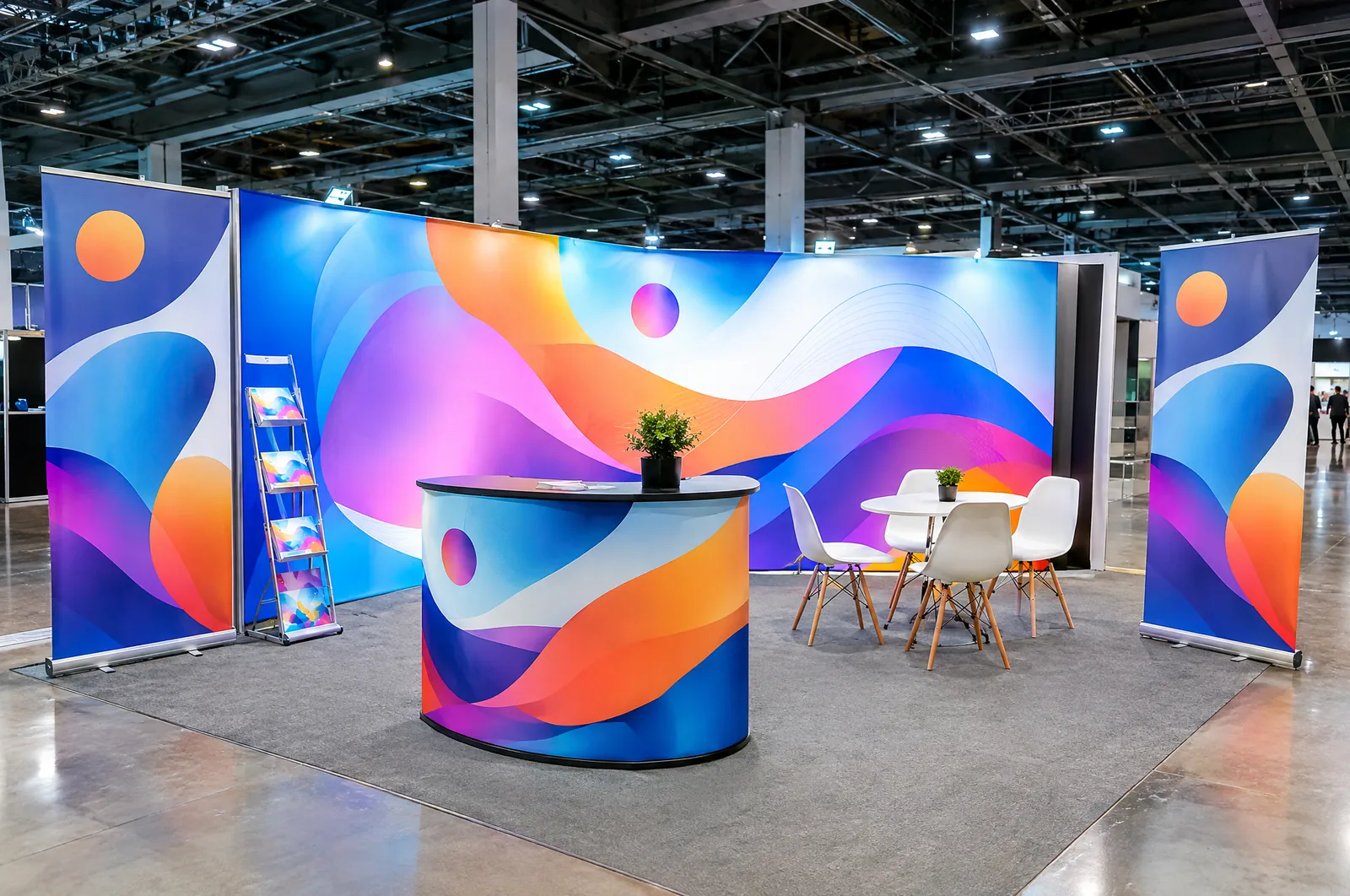
Typical stand sizes and what fits on them
Trade show organisers sell space in a few standard layouts. They determine how many walls you can put up and from where the stand is visible.
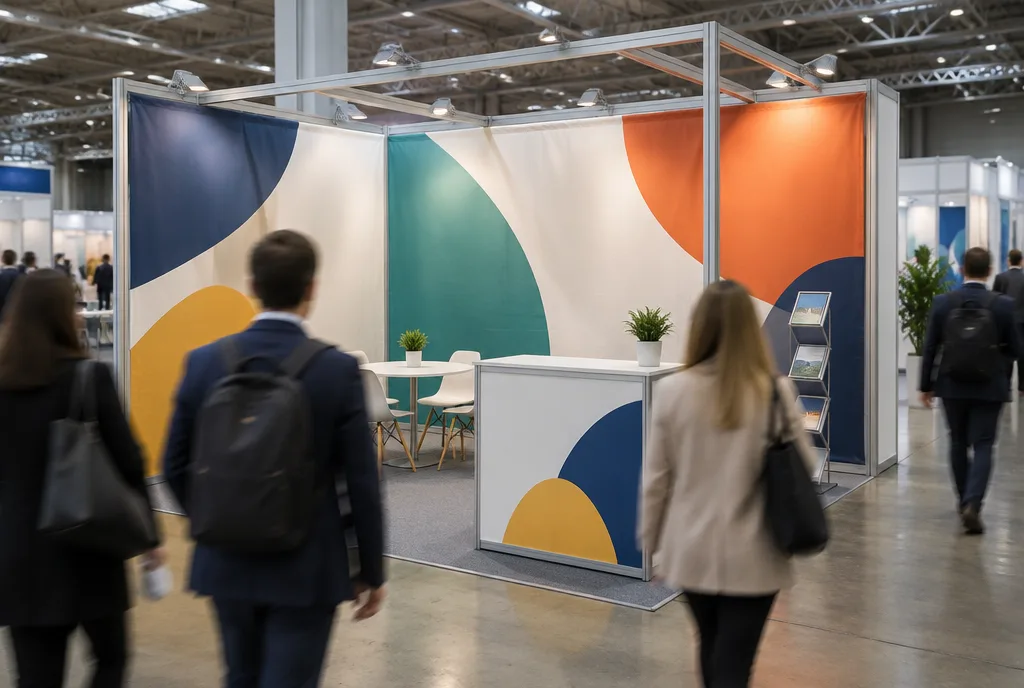
- 3 × 2 m or 3 × 3 m, inline stand – open on one side. One back wall, sometimes side walls. Room for a counter, a roller banner and 2–3 people.
- 6 × 3 m, corner stand – open on two sides. A back wall and one side wall, room for a meeting area.
- 6 × 6 m and larger, peninsula or island – open on three or four sides. This is where architecture begins: freestanding walls, a storeroom, rigging.
Before ordering anything, read the show's technical regulations. The organiser sets the maximum build height, distances from neighbours, rigging rules and the materials allowed into the hall. It happens that a 3 m wall is a dozen or so centimetres too tall, and you only find out in the hall.
How a modular system works
A modular stand is a set of lightweight aluminium frames into which fabric graphics with a sewn-in silicone edge are pressed (the SEG system). Modules are connected into straight walls, corners, walls with shelves or storeroom boxes. Then there are ready-made elements: pop-up displays, counters, roller banners, illuminated frames.
What this means in practice:
- tool-free assembly – two people put up a 3 × 3 m stand in an hour, larger ones in a few hours;
- transport in bags and cases – a kit for a small stand fits in the back of a van;
- glare-free graphics – fabric does not shine under spotlights, and photos of the stand come out clean;
- graphics replaced separately – when the offer changes we print only new fabrics, the frame stays;
- reconfiguration – the same modules make a small stand in one city and a larger one in another.
We print the graphics in-house on textile printers and sew the SEG edge in our own sewing room. More on the system itself in our guide SEG fabric frames explained, and ready-made kits are on the trade fair and promotional stands page.
Custom build: when it really makes sense
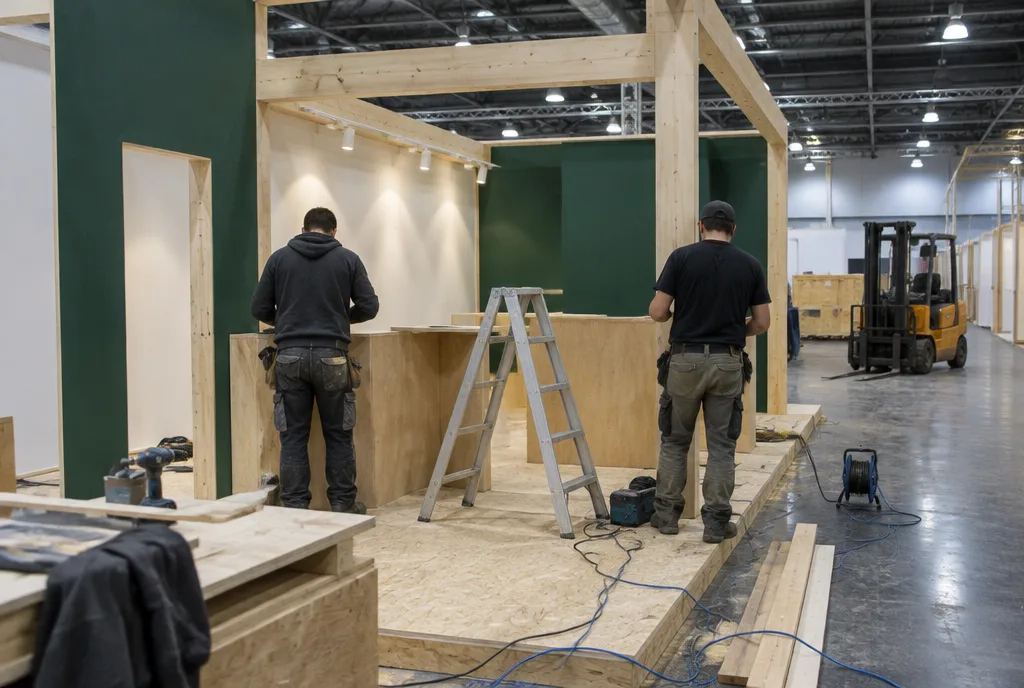
A custom (joinery) build is a stand designed from scratch for one event: board walls, painting, a raised floor, lighting, often an upper deck. It looks like a shop interior and can take any shape.
For:
- any form, height and materials – wood, stone, metal;
- a strong impression for major launches and premium brand stands;
- a storeroom with a door, storage, a kitchen – things a lightweight system cannot provide.
Against:
- the cost is incurred afresh at every show – design, build, installation, dismantling;
- longer preparation and build-up time in the hall;
- after the show there is a problem: store heavy elements or dispose of them.
In practice we increasingly see a middle way: a modular structure as the skeleton plus a few custom elements – a board counter with a routed logo, illuminated LED fabric frames or 3D letters above the stand. We make such elements in-house (CNC, UV printing on boards, 3D printing), and the stand still goes together without a joiner. A full custom build with an upper deck is quoted individually from the design.
What a system costs over 1, 3 and 10 shows a year
| Element | 3 × 3 m stand | 6 × 3 m corner stand |
|---|---|---|
| Back wall | 300 × 230 cm fabric backdrop – approx. €400 | 6 SEG modules 100 × 230 cm – approx. €950 |
| Side wall | — | 3 SEG modules 100 × 230 cm – approx. €480 |
| Counter | folding counter with graphic – approx. €210 | folding counter with graphic – approx. €210 |
| Extras | 2 roller banners 100 × 200 cm – approx. €125 | — |
| Total | approx. €735 | approx. €1,640 |
| New graphics for the next season | approx. €190 (backdrop) + approx. €60 (counter) | 9 × approx. €65 + approx. €60 = approx. €645 |
How it works out over a year:
- 1 show – you pay the full price of the kit. With a single event the difference from a custom build is smallest, but the system stays with you for other occasions: conferences, open days, showroom events.
- 3 shows – you divide the purchase cost by three. Even if you replace the graphics once, the cost per appearance for a 6 × 3 m stand is approx. €750, and for 3 × 3 m approx. €330 – plus transport and installation.
- 10 shows – the structure costs very little per event. Logistics and people become the main item, and you replace graphics only when the offer changes.
With a custom build most costs come up again at every show. That is why with several appearances a year the cost ratio almost always favours a system. A broader overview of budgets is in our guide how much does an exhibition stand cost.
- 24 hexpress printing (UV inks need no drying)
- approx. 3 daysstandard lead time
- up to 14 dayslarge and custom projects with installation
Plus courier delivery. Tell us your date — we plan production around it.
Transport, installation and storage
You can transport a modular system yourself or leave it to us. We have our own transport that runs across Europe regularly, and installation crews – a two-person team costs approx. €42 net per crew-hour plus travel at approx. €1 net/km both ways from Wieluń. Installation can be done without our company branding if the stand is handled by an agency.
Between shows the kit has to be stored somewhere. In an office it takes a few bags and one case. If you have no space, we can store it for you (approx. €26 net per pallet per month) and send it to the next event together with new graphics. The aluminium frames are practically indestructible, and fabric graphics can be washed and ironed – more in our guide how to store and transport a roller banner and backdrop.
Changing the configuration and graphics between shows
This is the system's biggest advantage, and it is not obvious at the first purchase. A few rules we recommend when designing:
- Plan modules of one width – e.g. 100 cm. Then you can build any wall from the same elements.
- Separate fixed graphics from changing ones – the logo and brand colours on modules that stay; products and slogans on those that change each season.
- Avoid one photo running across all the modules – it looks striking, but when the stand layout changes the graphic no longer lines up.
- Keep your files with us – a reprint of one fabric a year later has the same colour as the rest.
The full list of tasks before a show – from booking to ordering materials – is in our guide trade show preparation checklist.