 Signs & Large Format Print
Show regulations and organiser deadlines
Every trade show has its own technical regulations, and they set the whole calendar. Before ordering anything, it is worth extracting a few pieces of information from the organiser's documents:
- build-up and breakdown times – on which days and at what hours you may enter the hall, when the stand must be ready, by when it must be removed,
- maximum build height and rules for elements above neighbours' walls,
- material requirements – fire rating, certificates, banned materials,
- contractor registration – many shows require the installing company and its crew to be registered, sometimes with insurance,
- deliveries and unloading – where the vehicle enters, how long it may stay, whether a pass is needed, whether a mandatory forklift operator works on site,
- exclusive services – power, rigging, sometimes cleaning or installation are reserved for the organiser's contractors.
Application deadlines often pass several weeks before the show. Missing the deadline for rigging or a power connection can change the stand design. A general preparation list is in our guide trade show preparation checklist.
Production at home or on site: a comparison
| Criterion | Home production + transport | Contractor in the show country |
|---|---|---|
| Control over the look | Graphics and colours are visible before departure | Often only on site |
| Communication | In your own language, with a contractor you know | Usually in a foreign language |
| Production cost | Depends on the market; often lower in Poland | Local market prices |
| Transport | Must be organised and paid for | None or minimal |
| Reuse | The stand comes back and can go to the next show | Depends on the contract – often a one-off build or hire |
| Risk | Delay on the road, damage in transit | Less control over execution |
An exhibitor can choose: produce the stand at home and ship it to the show, or hand everything to a company in the show country. Both options make sense.
With modular systems – fabric frames, backdrops, counters – producing in Poland and shipping the stand usually works out well, because the same elements then go on to the next shows. With a large custom build, transport and the crew's days abroad start to count. The differences between these stand types are described in our guide modular or custom exhibition stand, and the costs in how much does an exhibition stand cost.
Transport: own vehicle, courier, trade show forwarder
The choice of transport depends on the size of the stand and whether there will be an installation crew on site.
- Luggage or the exhibitor's car – roller banners, pop-up walls, folding counters in bags and cases. A 300 × 230 cm fabric wall fits in a transport bag; the cheapest option for a small stand.
- Courier or dedicated courier – when the exhibitor flies and the stand has to be waiting on site. Check whether the hall accepts deliveries before build-up and where they are stored. A dedicated courier goes direct, with no transhipment, which matters for delicate elements.
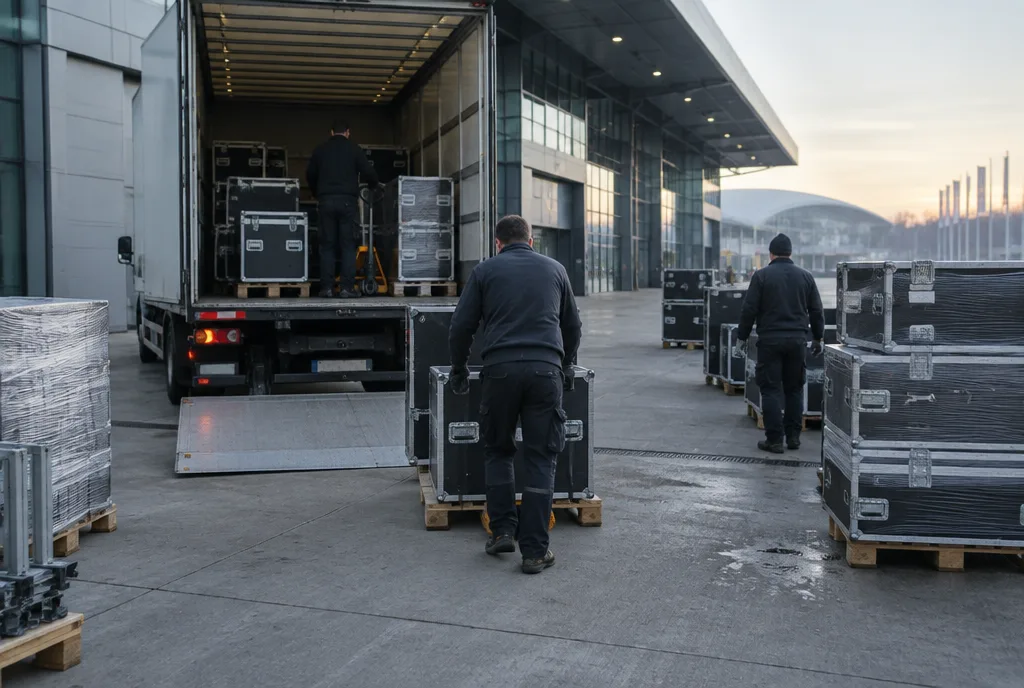
- The contractor's own vehicle with a crew – the stand travels with the people who will put it up. Our vehicles travel across Europe every day, so for shows in the EU and the UK this is a common option.
- Trade show forwarder – for large builds and shows with mandatory on-site logistics handling.
Whatever the method: we pack elements to survive several loadings (graphics on rolls or in tubes, rigid elements on a pallet), and every package is labelled. At shows where unloading takes an hour, labelled cases save a lot of stress. Shipping many parcels to different addresses is organised as part of our packing and multi-address shipping service.
Build-up and breakdown: crew, partners, access times
Portable systems are set up by the exhibitor – a pop-up wall or a counter takes from a quarter of an hour to under an hour. For a build with fabric frames, lighting and furniture it is better to have a crew who knows the system.
We organise installation at shows abroad in two ways: our crew travels with the vehicle and the stand, or partners in the country install to our drawings. Our own crew means more certainty about the result; partners mean fewer kilometres for shows far from Poland.
When planning, keep a few things in mind:
- Hall access times are set by the organiser; the crew must be on site at the start of its window, not the end.
- Tools and small items (screws, tapes, extension leads) travel with the crew – in the hall they are either unavailable or expensive.
- Breakdown is often shorter than build-up and frequently starts right after the show closes. The crew and vehicle must be planned for that moment too.
- Power and rigging are usually done by the organiser's services – they must be ordered in advance.
We price crew labour from approx. €42 net per crew-hour for a two-person crew, with travel charged per kilometre both ways. For shows abroad the exact cost depends on the number of days and overnight stays – we confirm it once you contact us.
- 24 hexpress printing (UV inks need no drying)
- approx. 3 daysstandard lead time
- up to 14 dayslarge and custom projects with installation
Plus courier delivery. Tell us your date — we plan production around it.
Fire-rated materials and hall requirements
Most exhibition halls require the materials used on a stand to meet a specific reaction-to-fire class – this applies particularly to fabrics, floor coverings and decorations. Requirements and class names differ between countries and organisers, so we always start with the show's technical regulations.
What this means in practice:
- if the regulations require a certificate, you must have it with you on the stand – an inspector may ask for the document,
- on request we check the availability of material with the relevant certificate before production; this may affect the choice of fabric and the price,
- decorations added at the last minute (balloons, paper decorations, cardboard standees) are also subject to the hall's rules.
Do not assume that a material approved at one show will pass at another. If you exhibit regularly at several events, it is worth choosing materials for the strictest requirements from the start.
Storing the stand between shows
A stand that travels to several shows a year has to be kept somewhere. Aluminium frames are tough, but fabric graphics do not like damp and creases, and board counters do not like knocks.
Some clients leave the stand with us. Storing graphics and stand elements costs approx. €26 net per pallet per month, palletising with stretch wrap approx. €19 net. Before the next show we check the condition of the graphics and print new ones if needed – with fabric systems only the print is replaced, not the whole structure. A 100 × 230 cm SEG frame module with graphic costs from approx. €160 net, a replacement graphic for it from approx. €65 net. All prices are indicative; we confirm them once you contact us.
How to look after portable systems so they survive many trips is described in our guide roller banner care, storage and transport.