 Signs & Large Format Print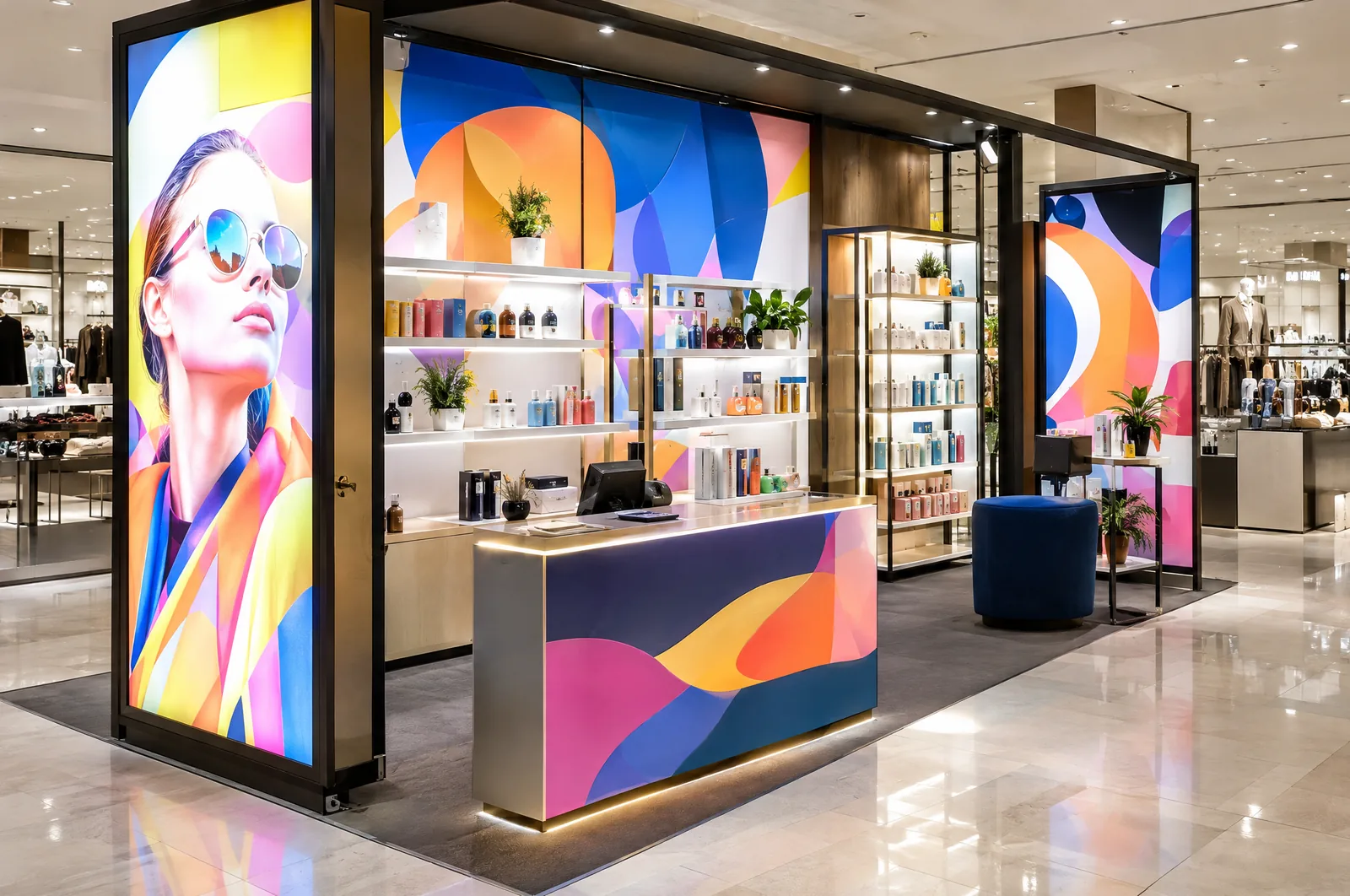
Shop-in-shop, corner, gondola: how they differ
In talks with a retailer these terms are often mixed up, and the budget depends on them.
- Gondola or brand display – a fixture or part of one in the manufacturer's colours: price strips, a header with the logo, wobblers, sometimes an illuminated panel. The cheapest form, fitted to the store's existing furniture.
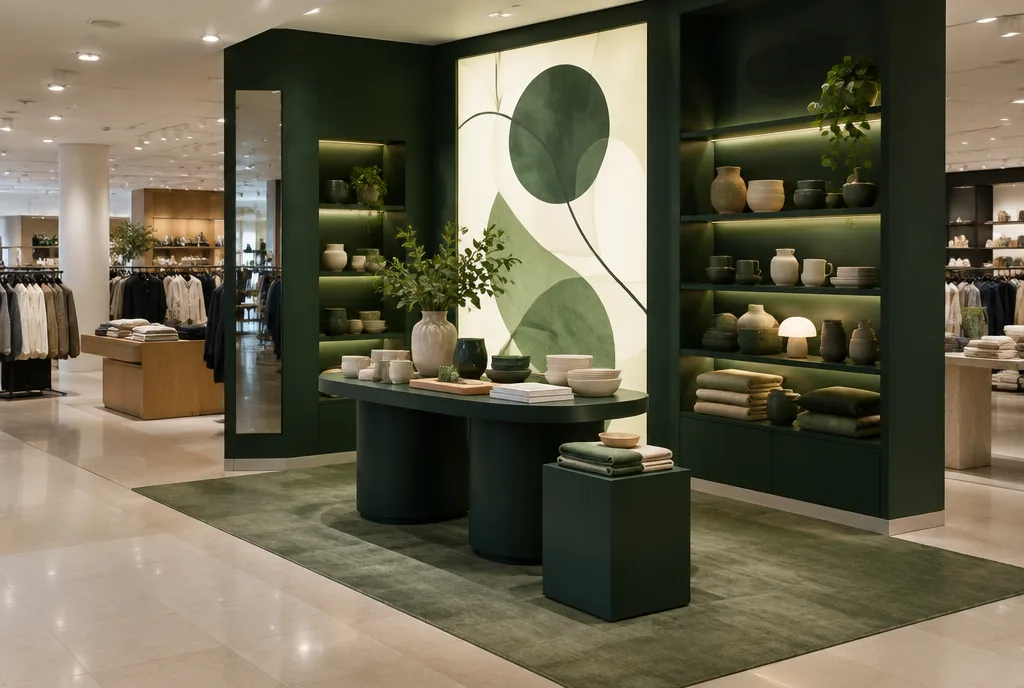
- Corner – a corner or section of wall assigned to the brand. Its own backdrop (a wall with graphics), its own display, usually without an enclosed space.
- Shop-in-shop – a separate zone with its own build, floor, lighting and often staff. Customers feel they have walked into a small brand store.
The further down this list, the more agreements with the retailer and the more important it is that the design is repeatable. A short explanation of the basics is in our guide what is POS display material.
Agreeing with the retailer: what to ask before the design
Retail chains usually have a department that approves manufacturers' fit-outs, and their own guidelines. Before the designer starts drawing, get answers to these questions:
- Dimensions and height – the available area, maximum build height, distances from fixtures and escape routes.
- Materials – whether a specific reaction-to-fire class is required, bans on certain plastics, floor requirements. On request we check the availability of certified materials.
- Fixing – whether drilling into walls and floor is allowed, or whether the build must be freestanding.
- Power – whether there is a socket, what load, who connects the lighting.
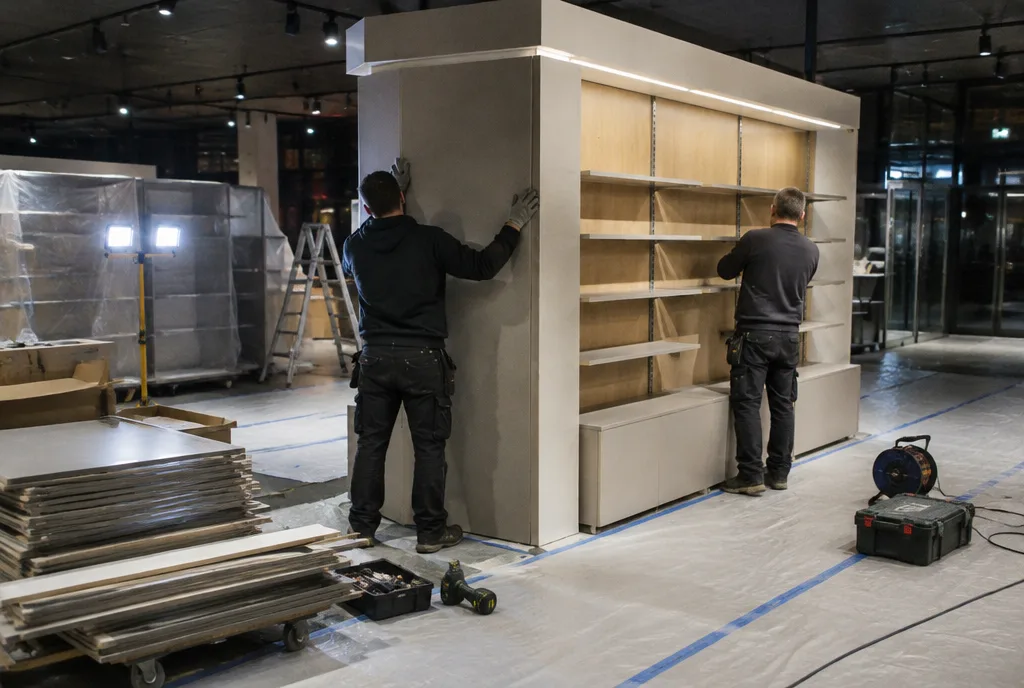
- Installation – hours (often at night), delivery access, floor protection, who signs off the work.
- Price communication – whether prices are on the retailer's rails or in the brand's materials.
This information differs between retailers and even between stores of the same chain. That is why for larger rollouts we start by surveying representative stores.
A modular build for many stores
If the zone is going into a dozen or several dozen stores, it is designed like building blocks. A few modules of fixed width from which variants are assembled: small (e.g. 2 modules), medium, large. That way production is serial and installation repeatable.
With us a typical set is built from:
- SEG fabric frames – walls and backdrop, graphics replaceable without dismantling the frame,
- board displays – countertop displays in corrugated board (approx. €13–21 net/m² with print) or acrylic (approx. €43–60 net/m²), acrylic bending approx. €6 net per metre of bend,
- lightweight plinths and cubes in honeycomb board (approx. €30–45 net/m²),
- CNC-routed elements – logos, shelves, covers.
Board works for promotions lasting a few weeks; acrylic, Dibond and aluminium frames for permanent zones. Cardboard displays are compared in our guide cardboard POS display.
Graphics, lighting and price communication
In a store you are competing for attention with hundreds of other packs, so the brand zone must be readable from several metres.
- One main message on the backdrop – the logo and a slogan at eye level, not a crowd of photos.
- Light – an illuminated fabric frame (SEG face, from approx. €300 net/m²) or an ultra-slim light box with a replaceable graphic (A1 from approx. €165 net) makes the zone stand out in a uniformly lit hall. More: illuminated LED fabric frames.
- Prices and promotions – shelf strips, wobblers and shelf stoppers in brand colours, but consistent with the retailer's pricing system. Prices on brand materials go out of date quickly; it is better to plan replaceable inserts.
- Floor – floor graphics with anti-slip laminate (approx. €19–30 net/m²) mark out the zone without putting up walls.
- 24 hexpress printing (UV inks need no drying)
- approx. 3 daysstandard lead time
- up to 14 dayslarge and custom projects with installation
Plus courier delivery. Tell us your date — we plan production around it.
Series production and installation at many locations
This is usually where a project succeeds or fails. The plan we use for retail rollouts:
- Survey of representative stores (approx. €85 net per site, refunded when you order production) and a list of variants.
- Prototype of one zone – trial installation, corrections, retailer approval.
- Series production – all elements from one batch so the colours are consistent.
- Kitting per store – each store gets a complete set labelled with its address (approx. €3.30 net per location) and shipping or delivery with installation (multi-address shipping approx. €2.80 net per location).
- Installation – our own crews in Poland and Europe, at night if the retailer requires it (from approx. €65 net per hour).
- Report – photos from every store after installation.
The whole process is described on the network rollout with reporting page. We serve agencies as white label – crews install without our branding.
Service and campaign changes
A brand zone lives longer than one campaign. Agree straight away who replaces the graphics and how often, who repairs damaged elements and where spares are kept. With SEG frames a campaign change means shipping new fabrics – the fabric is pressed into the frame groove without tools, so there is usually no need to send an installation crew. We can store spare graphics and elements and ship them on demand.