 Signs & Large Format Print
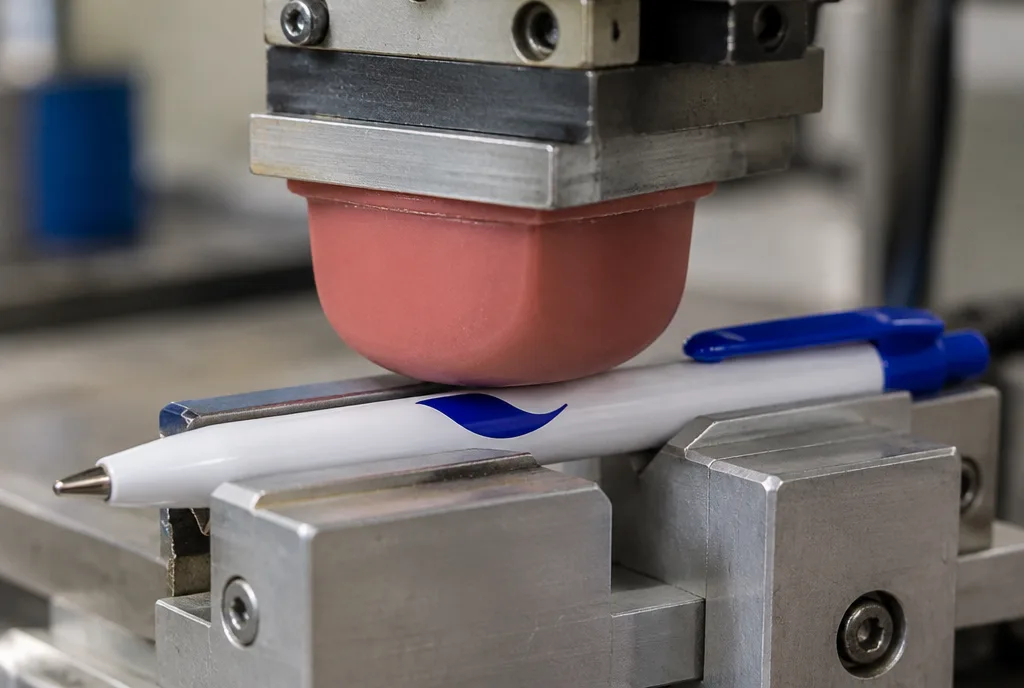
Pad printing: small and curved surfaces
Pad printing transfers ink from a flat plate onto the item using a soft silicone pad. The pad conforms to the curve, which is why it is the standard method for pens, lighters, keyrings, USB stick casings and anything small and rounded.
- Pros: precision in a small area, low unit cost, printing on awkward shapes.
- Cons: the print area is usually only a few centimetres, each colour is a separate plate and pass, so a multicolour logo quickly gets expensive. Photos and tonal gradients are not done by pad printing.
Practical tip: if the logo has thin lines or very small text, prepare a simplified version. On a pen 1 cm in diameter, a small strapline under the logo will be unreadable anyway.
Screen printing: large runs and solid colours
In screen printing ink is pushed through a mesh carrying an exposed pattern. It gives a thick, opaque layer that adheres well to textiles, paper, plastics and glass. It is the standard for bags, T-shirts, mugs (in the fired version) and flat merchandise.
- Pros: very durable, saturated colour, including white on a dark background; the lowest unit cost for large runs.
- Cons: the cost of preparing a screen for each colour – not worth it for 30 pieces; full colour and photos only to a limited extent.
Choose screen printing when the logo has 1–3 colours and the run is in the hundreds. For ceramic mugs, screen printing or a decal fired in a kiln is the most durable option – more in our guide branded mugs.
Full-colour UV printing: short runs
UV printing applies ink that is instantly cured by UV light. It prints in full colour, with white as an underlayer, on flat and slightly curved surfaces: plastic, metal, glass, wood, faux leather.
- Pros: no plate costs – it pays off from single pieces; photos, gradients, many colours at one price; every piece can be personalised.
- Cons: on items washed and scrubbed daily (mugs in a dishwasher) it loses out to firing and engraving; it needs a flat or regular print area.
In-house we also UV-print on boards and client-supplied materials up to 50 mm thick – this is how plates, acrylic keyrings, coasters, packaging and display elements are made. UV printing on supplied glass, metal or wood costs approx. €18–34 net/m² with us depending on the substrate. How the technology works is explained in our guide what is UV printing.
Laser engraving: metal, wood, glass
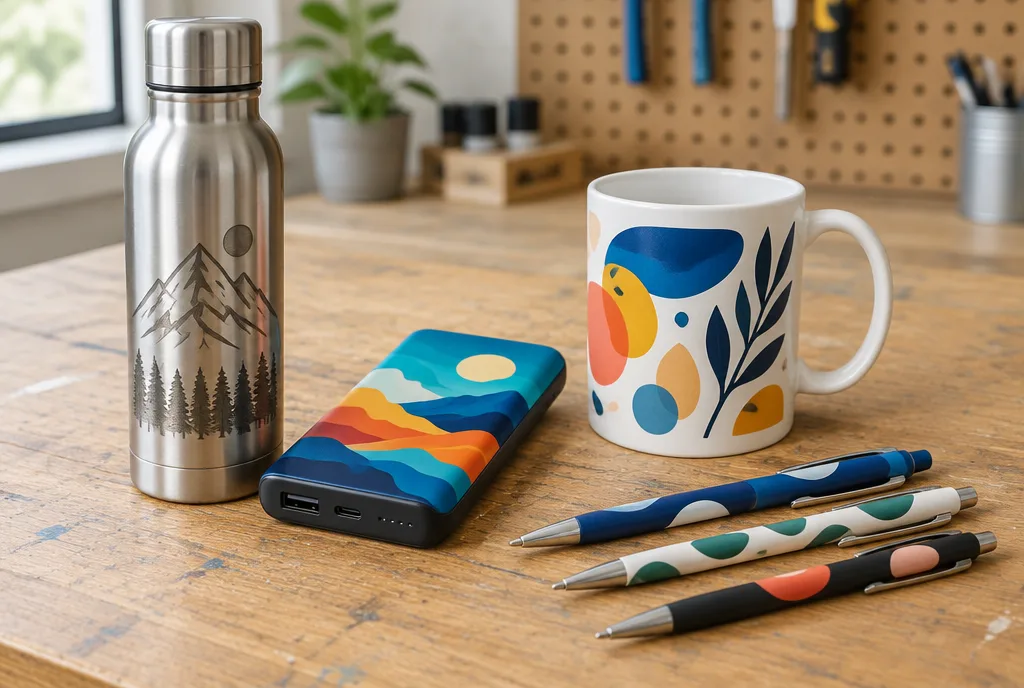
A laser does not add ink – it removes or changes the top layer of the material. On painted steel it reveals the metal, on anodised aluminium it leaves a light mark, on wood and bamboo it scorches the surface brown, on glass and acrylic it frosts.
- Pros: cannot be rubbed or washed off, looks elegant, needs no plates – good from a single piece; ideal for personalising names and numbers.
- Cons: one colour – the colour of the material itself; it cannot reproduce a brand colour.
Engraving is the standard on flasks, metal pens, power banks, pocket knives and awards. For our own acrylic, plywood or wood elements we engrave in-house: surface engraving costs approx. €0.55 net per dm², and series marking from 100 pieces approx. €0.25 net each (minimum laser order approx. €14 net). More in our guide laser engraving and cutting.
- 24 hexpress printing (UV inks need no drying)
- approx. 3 daysstandard lead time
- up to 14 dayslarge and custom projects with installation
Plus courier delivery. Tell us your date — we plan production around it.
Embroidery, transfer and sublimation on textiles
Embroidery – the logo is stitched in thread. It looks solid and expensive, best on fleeces, caps, polo shirts and towels. It needs a one-off embroidery programme to be prepared and cannot reproduce fine details or gradients.
Transfer – a print applied with a heat press. Full colour, good for small runs and personalisation (a name, a player number). An A4 transfer print on a T-shirt costs approx. €3.30 net with us for 20–49 pcs, approx. €2.35 for 50–99 pcs and approx. €1.90 from 100 pcs.
Dye sublimation – the dye penetrates polyester fibres. The print cannot be felt, does not crack or peel, but only works on light-coloured polyester materials. The standard for lanyards, flags and sportswear – a comparison is in our guide printed lanyards.
How to choose between embroidery and print on clothing is covered in a separate guide branded clothing: embroidery or print.
Table: material, method and quantity
| Material / item | Most common method | Alternative | From what quantity it pays off |
|---|---|---|---|
| Plastic pen | pad printing | UV printing (full colour) | pad printing usually from hundreds; UV from a few dozen |
| Metal pen, flask, power bank | laser engraving | pad printing, UV printing | engraving from single pieces |
| Ceramic mug | fired print (screen print, decal) | sublimation, UV printing | firing from a few dozen to 100 pcs; sublimation from 1 pc |
| Bottle, plastic cup | pad printing, screen printing | UV printing | usually from 50–100 pcs |
| Cotton bag | screen printing | transfer, DTG | screen printing from approx. 100 pcs; transfer and DTG from a few dozen |
| T-shirt, sweatshirt | screen printing, transfer | embroidery | transfer from 20 pcs; embroidery for longer use |
| Lanyard, flag, sportswear | sublimation | screen printing | from a few dozen pieces |
| Wood, bamboo, cork | laser engraving | UV printing | from single pieces |
| Glass, acrylic | engraving, UV printing | screen printing | from single pieces |
The thresholds are approximate: the real minimum depends on the specific item and its supplier. Example prices from our offer: a 450 ml ceramic mug with a 1-colour print for 100 pcs from approx. €6 net, a 750 ml bottle from approx. €3.05, a 16 GB USB stick with logo from approx. €4.90, an engraved power bank from approx. €15 net each. The full list is on the branded office and writing gadgets and branded mugs, bottles and flasks pages. If you are still matching merchandise to a budget, start with our guide choosing promotional merchandise.