 Signs & Large Format Print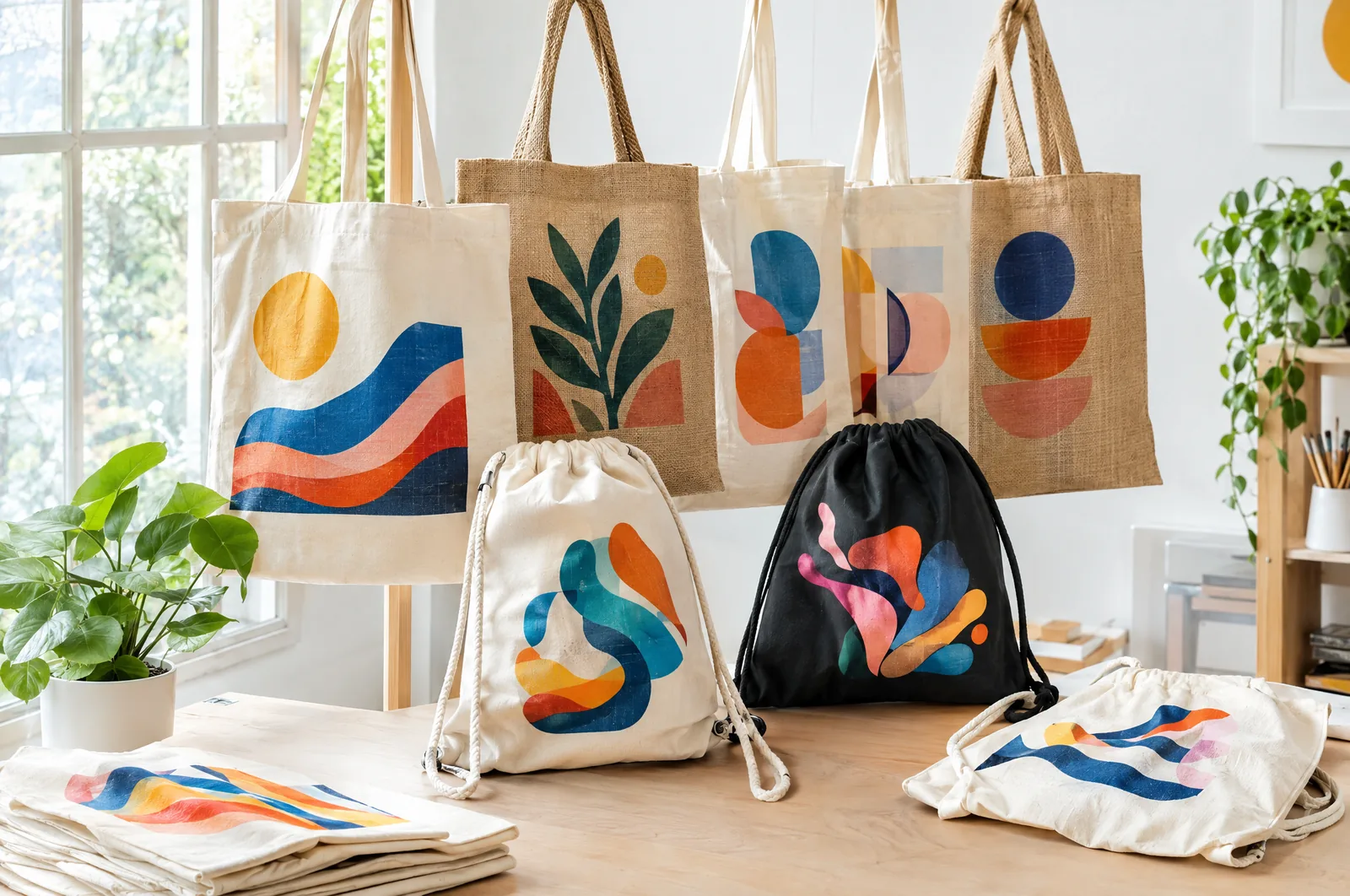
Four materials: how they differ
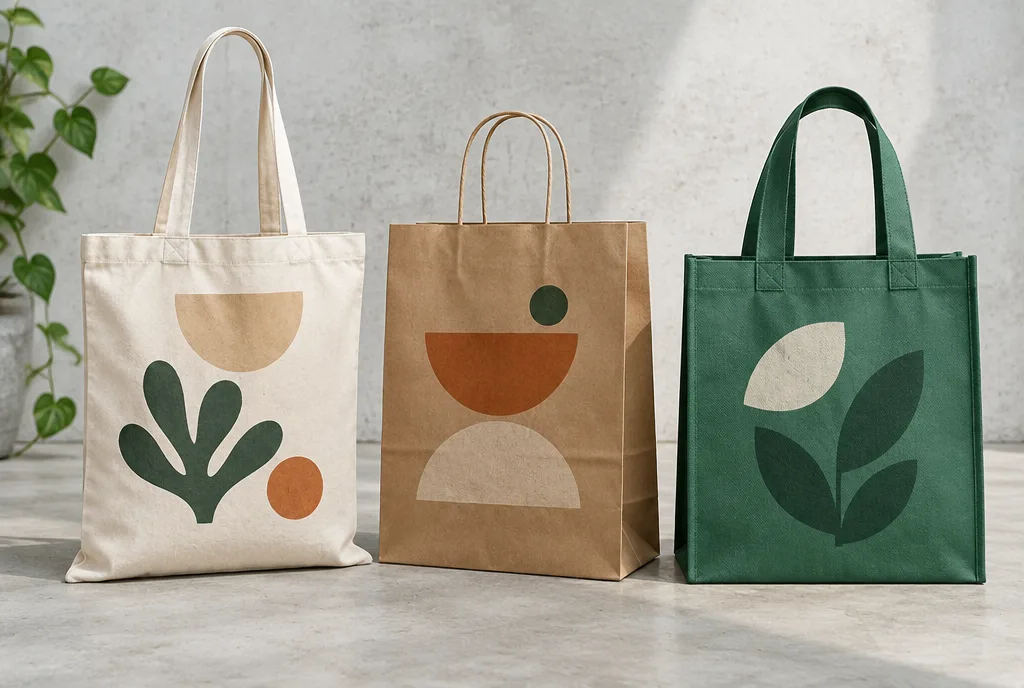
Cotton. A natural fabric, soft and strong. The bag can be washed, carried for years and folded into a pocket. It takes screen printing, transfer and direct-to-garment (DTG) printing well. It is the bag people keep – and that is why it shows your logo the longest.
Paper. Brown or white kraft, sometimes coated paper with lamination. Rigid, with flat or twisted handles. Best for shops, boutiques, patisseries and gift wrapping. It survives a few uses, then goes into paper recycling. Paper and handle details are covered in our guide printed paper bags with logo.
Non-woven (polypropylene fabric). Light, cheap, moisture-resistant, with a characteristic felt-like look. Popular in conference packs and at trade shows. Remember that it is a plastic – in eco-focused campaigns it may be poorly received.
Jute. A thick, coarse natural fabric. It looks rustic and suits delicatessens, wine and regional products. Printing on jute is less precise – small lettering and thin lines blur.
Cotton weight and strength
For cotton bags you will most often come across fabrics of about 140–180 g/m² and heavier ones of about 220–280 g/m² and more. The difference is clear in the hand:
- lighter cotton – light, cheaper, good for a conference pack, flyers, a catalogue, small purchases; with heavy items (bottles, books) it stretches over time;
- heavier cotton – stiffer, holds its shape, does not show through, and the print looks more premium; it is the bag people use for shopping for years.
Look at the handles too: short ones only fit in the hand, long ones let you carry the bag on your shoulder. At trade shows and conferences, where people carry the bag all day, long handles are much more comfortable. For a bag meant for heavy items, ask about a gusseted base, because a flat bag stretches quickly.
Bag printing methods
- Screen printing – ink pushed through a screen, one screen per colour. A very durable, saturated print, economical for larger runs in 1–2 colours. For short runs the cost of preparing screens raises the unit price.
- Transfer (heat transfer) – the print is transferred onto the fabric with a heat press. Full colour, good for short runs and personalisation. On thick, coarse fabric it may hold less well than screen printing.
- DTG (direct-to-garment) – full colour without screens, good for photos and multicolour graphics from a few dozen pieces.
- Dye sublimation – only on polyester fabrics, not on cotton. Gives full colour across the whole bag.
- Printing on paper – paper bags are usually printed in full colour (CMYK) before the bag is glued, or on a finished bag in a smaller area.
A comparison of methods on other merchandise – mugs, pens, electronics – is in our guide promotional product branding methods, and on clothing in embroidery or print.
What a bag costs at different quantities
| Bag | Quantity | Price for the run | Price per piece |
|---|---|---|---|
| Kraft paper 240 × 340 × 90 mm, full colour 4/0 | 100 pcs | approx. €185 | approx. €1.85 |
| Kraft paper 240 × 340 × 90 mm, full colour 4/0 | 500 pcs | approx. €580 | approx. €1.15 |
| White cotton 38 × 42 cm, DTG one side | 50 pcs | approx. €270 | approx. €5.40 |
| White cotton 38 × 42 cm, DTG one side | 100 pcs | approx. €400 | approx. €4 |
| Cotton, 1-colour print | 100 pcs | — | from approx. €2.10 |
| Non-woven, jute, other sizes | as needed | individual quote | depends on size and print |
The table shows two things. First, quantity lowers the unit price more than the choice of material. Second, the number of colours matters a great deal with cotton: a one-colour logo costs a fraction of a full-colour photo. If your identity allows it, simplify the artwork to one or two colours.
The offer is on the fabric bags and sacks and printed paper bags pages. Prices are indicative – after a short description (material, size, number of colours, quantity, deadline) we give the exact amount.
- 24 hexpress printing (UV inks need no drying)
- approx. 3 daysstandard lead time
- up to 14 dayslarge and custom projects with installation
Plus courier delivery. Tell us your date — we plan production around it.
Which bag for a trade show, a shop, a conference
- Shop and boutique – paper. It looks smart, goes well with the packaging and is not associated with plastic. For premium products – coated paper with lamination and rope handles.
- Trade show – non-woven or light cotton. People collect catalogues from the whole hall in it, so the bag must be roomy and light. A large logo on both sides, because the bag is visible in the crowd.
- Conference and training – cotton with long handles. Delegates get their materials in it and then use it at home.
- Gift for clients and staff – heavy cotton or jute, often as packaging for a branded gift set.
- Race or competition starter pack – a polyester or cotton drawstring bag, light and practical.
The full list of materials for corporate events is in our guide conference and gala advertising materials, and ideas for organisers in the section for event organisers.
Ecology and rules on bags
There is no single most eco-friendly bag. Cotton needs a lot of water and energy to produce – life cycle analyses show it has to be used many times before its footprint beats thinner bags. Paper is renewable and easy to recycle, but usually has a short life. Non-woven is durable, but it is a plastic.
The practical conclusion: the most eco-friendly bag is the one someone uses for a long time. That is why it is better to order fewer, better bags than to hand a flimsy one to everyone.
EU rules mainly restrict lightweight plastic carrier bags, and individual countries introduce their own charges and bans. If the bag is going into a shop as packaging for customers, check the current rules in your country – this applies especially to plastic bags.