
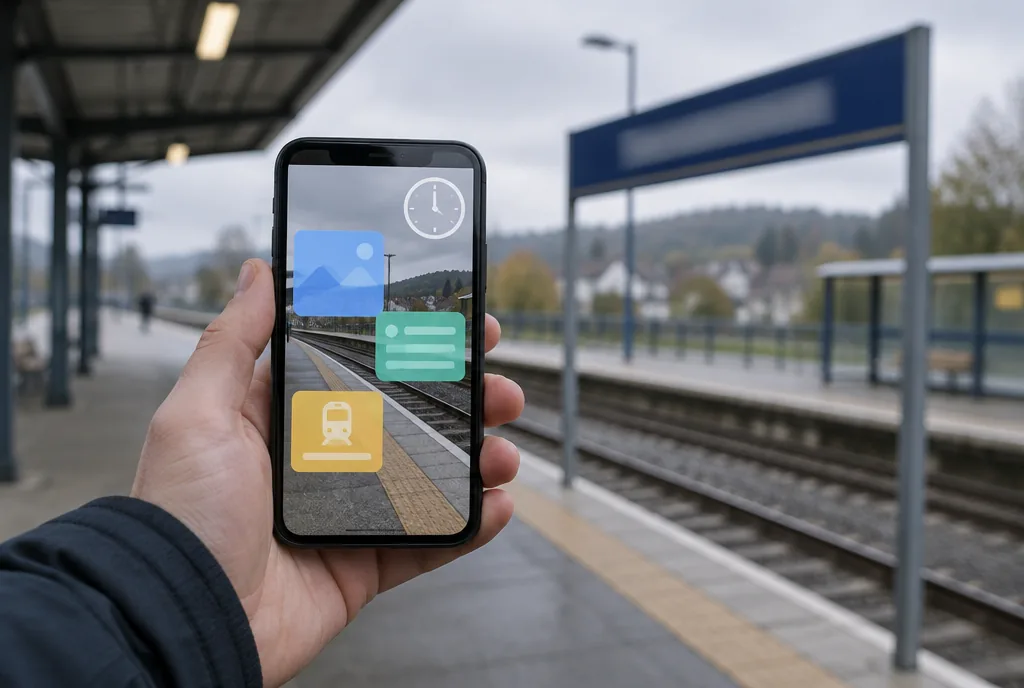
 Illustrative visualisation
TECHNOLOGY · AR · PASSENGER INFORMATION
Koleje Śląskie · delivered by: RunvidoKoleje Śląskie AR: augmented reality as a new interface for rail information
A passenger standing on the platform pointed their phone at the station name, and the Koleje Śląskie AR app showed them the expected train arrival and the reason for any delay. For about five years Runvido developed this technology layer for the operator: recognising the surroundings, presenting data in the app and integrating with service information systems. The cooperation ended by mutual agreement.- About 5 years of technology cooperation
- Pointing a phone at the station name instead of searching for a service
- The reason for a delay, not just the number of minutes
- Changing information without replacing station signage
01 Context and challenge
A regional rail passenger usually asks two questions: when will my train arrive, and why is it late? The timetable, departure boards and announcements answer the first. The second often goes unanswered. The passenger sees a delay of a dozen or so minutes but does not know whether it is a breakdown, an emergency services intervention or an incident on the line, and therefore does not know whether to wait or look for another connection.
A station also has fixed, physical information infrastructure: name boards, platform signage, display cases. Changing it is expensive and slow, while train running data changes many times a day. The challenge was therefore to link what the passenger has in front of them with dynamic passenger information, without adding new boards and without changing the existing station signage.
02 Our role and solution
This is a technology case delivered by Runvido, not a Wielka Reklama print job.
What we did. For Koleje Śląskie we developed the Koleje Śląskie AR app. Its main function was simple to use: the passenger pointed the phone camera at the name of a station or stop, the app recognised the location and displayed the expected train arrival and the reason for the delay, if that information was available.
Our responsibilities were:
- the augmented reality and image-recognition mechanism that linked physical signage with digital content,
- the layer presenting service and disruption data in the mobile app,
- integrating the app with information systems on services, delays and the causes of disruption,
- developing and maintaining the solution throughout the cooperation.
What we did not do. We were not the source of train running data, nor did we operate the operator's dispatch systems. We did not design, print or install the station name boards; the app used the existing signage. Nor were we responsible for the content of disruption messages: preparing them was the job of the operator and its staff.
03 How we worked
With a passenger app, the most important thing was for the path from an incident on the railway to the phone screen to be clear. Information about an incident, for example an emergency services intervention, went from railway staff to the control centre, partly in the form of text messages. From the control centre the data was made available in digital channels, and the Koleje Śląskie AR app presented it to the passenger in the context of a specific station.
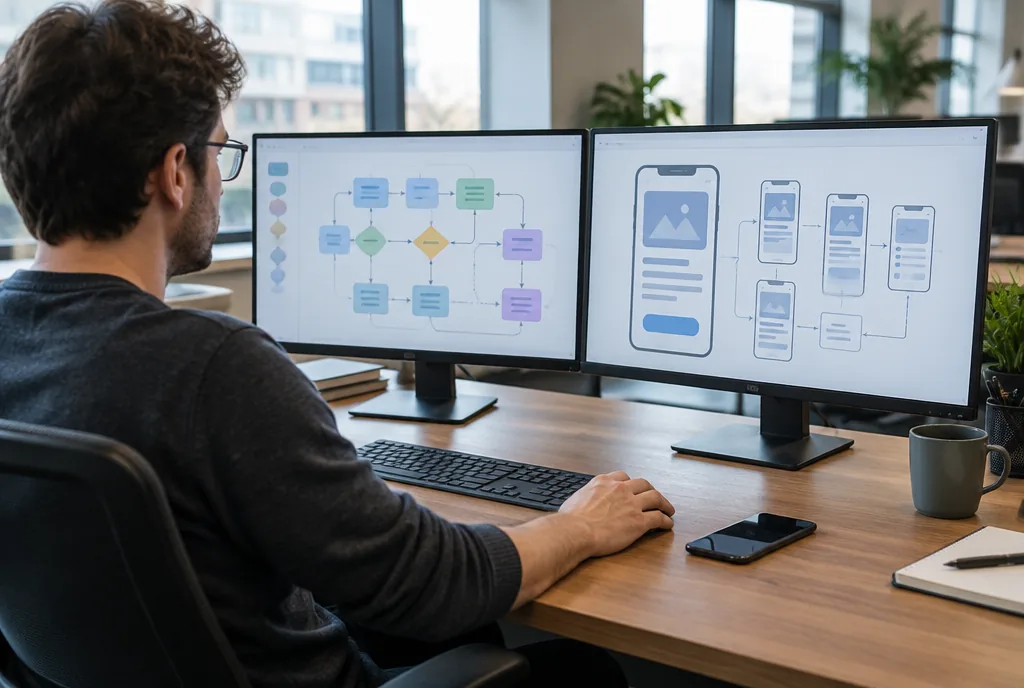
A solution like this requires two layers to be kept separate. The first is fixed: recognising the place where the passenger is standing. The second is variable: services, delays and the causes of disruption. This meant the information could be updated on the data side, while the physical station signage stayed unchanged. It is the same model we apply to printed materials in other Runvido projects: the medium stays the same, and the digital content can be replaced.
How current the displayed information was depended on when the data reached the central system and how often it was retrieved from it. That is why we describe it as an expected arrival and a current disruption message, not as a guaranteed technical parameter.
The cooperation lasted about five years and ended by mutual agreement. During that time the app was developed in parallel with the operator's information systems.
04 Results
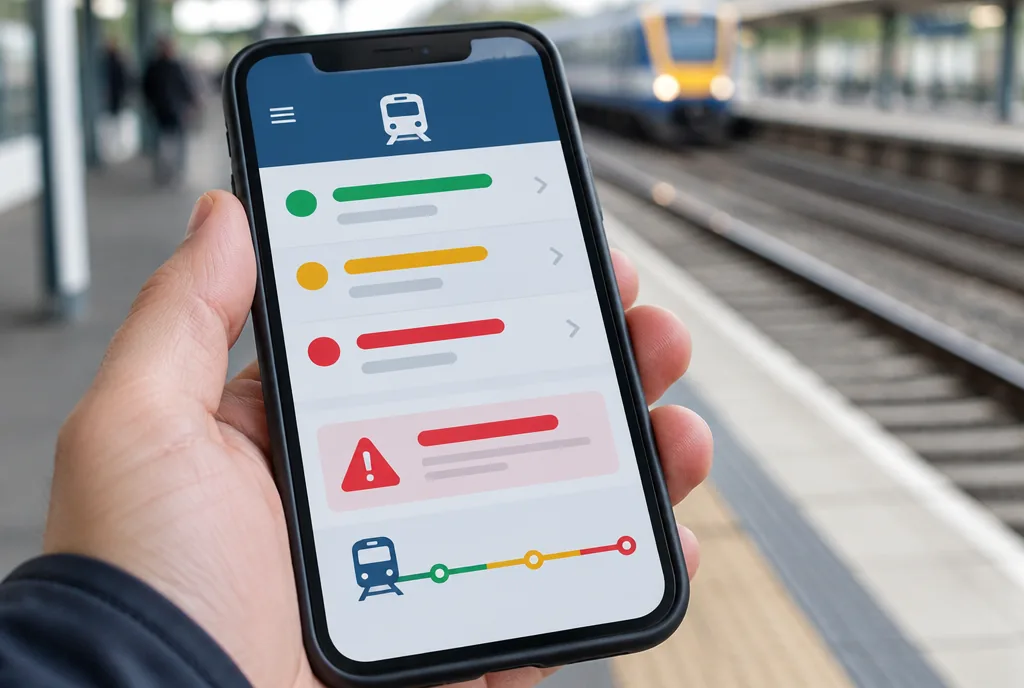
Passengers gained a new, interactive information channel: instead of looking up a service in the timetable, they pointed their phone at the name of the station where they were standing. The most valuable element was the reason for the delay, the context that is usually missing from departure boards and short announcements. For the operator, the solution made it possible to show changing data where passengers need it, without changing the station signage.
We do not give the number of downloads, users or satisfaction scores.
05 What set us apart
In most Runvido projects augmented reality brings an advertising material to life: a leaflet, a poster or a print. Here the same mechanism was applied to railway information infrastructure, and the content was operational data rather than a promotional video. Combining image recognition with train running data integration turned an ordinary station name board into an entry point to up-to-date information. We applied similar logic, variable content assigned to a fixed medium, in the project for InterRisk, where one leaflet led to the right agent in the region. We use our experience with integrations and building web and mobile apps in projects where a physical place needs to lead to current data.
FAQ · Koleje Śląskie
Frequently asked questions
Does an AR app require new station signage or QR codes?
In the Koleje Śląskie AR project the entry point was the name of the station or stop, i.e. the existing signage. Passengers pointed their phone at it and the app recognised the location. The choice of recognition method depends on site conditions, and we discuss it for each project.
Where does the app get delay information from?
The app does not create data itself. It presents data after integration with the information systems of the operator or transport authority. How current the information is depends on how quickly it reaches the source system and how often it is retrieved.
Would a solution like this work outside the railway?
The "physical point + variable data" mechanism fits anywhere signage is fixed and information changes often: branch networks, industrial sites, public buildings. We agree the scope of integration with the data owner.
Product enquiry
Ask about: Koleje Śląskie
A few quick questions so we know straight away what your enquiry is about. Prices are approximate; we confirm the final price after we talk.Your name and an e-mail address or phone number are enough. You can add the rest now or we can sort it out by phone.WIELKA REKLAMA · CASE STUDY